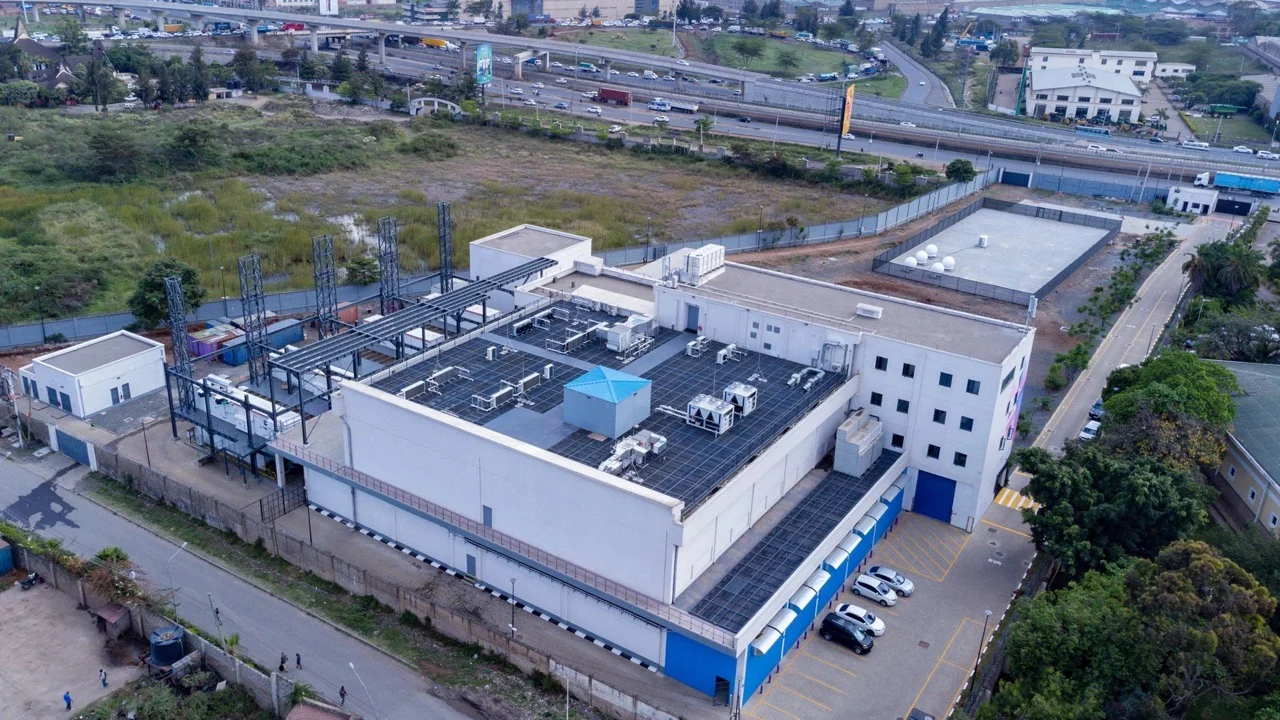
Reliable, scalable, and sustainable infrastructure, particularly data centres powered by renewable energy, will determine whether Kenya emerges as East Africa’s leading AI hub or remains a consumer rather than a creator of advanced technologies.
As global AI demand surges, countries with robust digital foundations are well positioned to capture value in model training, inference, and innovation.
Kenya’s National AI Strategy 2025–2030 explicitly recognises this reality, prioritising AI-ready data centres, green energy integration, and targeted incentives to position the country competitively.
Recent developments highlight the urgency: the national data-centre market is projected to grow from USD 266 million in 2025 to USD 805 million by 2031 at a CAGR of 20.27%, driven by AI workloads and cloud adoption.
Developments in Data Centres
Kenya is rapidly expanding its data centre capacity to meet AI requirements. Nairobi currently hosts eight operational facilities and seven under development, with key players including Africa Data Centres, iXAfrica, and Nxtra by Airtel.
Airtel’s 44 MW hyperscale project in Tatu City, East Africa’s largest, broke ground in 2025 and is scheduled for early 2027 operations, featuring GPU-ready racks and redundant fibre paths.
Strategic partnerships are accelerating progress. In January 2026, iXAfrica collaborated with Oracle to deliver Kenya’s first public cloud region, while Safaricom partnered with iXAfrica to launch AI-ready services for enterprise clients.
The National AI Strategy outlines construction of three Tier III-compliant AI data centres with 400/800GE ports, liquid cooling, and PUE targets below 1.3, aiming for high-performance computing clusters and edge capabilities.
These investments align with the Cloud-First Policy and the National Digital Master Plan, enabling local hosting of AI workloads and reducing latency for regional applications in fintech, healthcare, and agriculture.
Renewable Energy Integration for AI Infrastructure
AI data centres are power-intensive, and Kenya’s renewable energy advantage is a decisive differentiator. Over 80–90% of the country’s electricity comes from geothermal, solar, wind, and hydro sources, with geothermal providing stable baseload power from the Rift Valley.
The flagship Microsoft–G42 project in Olkaria exemplifies this potential: a USD 1 billion geothermal-powered data centre campus with an initial 100 MW capacity scalable to 1 GW, leveraging Kenya’s 10 GW geothermal potential.
KenGen has deployed battery energy storage systems (BESS) to support modular data centres, while Special Economic Zones in Olkaria and Konza facilitate dedicated green-energy parks.
READ ALSO:What Is the Human Cost of Training AI Systems?
These initiatives target near-zero-carbon operations and position Kenya as a “green compute” leader in a global market increasingly scrutinised for emissions.
Compared with coal-dependent grids in parts of South Africa or Nigeria’s gas-reliant infrastructure, Kenya offers lower-carbon, more predictable power critical for ESG-compliant investors and hyperscale operators facing energy constraints elsewhere.
Incentives and Policy Support for Tech Investment
Kenya is actively enhancing its investment attractiveness through targeted reforms. At the Kenya International Investment Conference (KIICO) 2026, over USD 2.9 billion in deals were announced across ICT and related sectors.
Policy measures include zero-rating VAT on exported digital services, tax offsets for verified claims, and removal of the 30% domestic equity requirement for ICT firms.
Special Economic Zones provide tax breaks, streamlined permitting, and one-stop facilitation. The forthcoming digitisation of the One-Stop Investment Centre by end-2026 will further reduce bureaucratic friction.
These incentives, combined with the National AI Strategy’s public-private infrastructure pillar, create a favourable environment for both local and foreign capital.
Kenya’s Competitive Advantages Relative to Other Regions
Kenya’s strengths extend beyond energy and policy. The Silicon Savannah offers a youthful, English-speaking, tech-literate workforce and a mature startup ecosystem that complements infrastructure development.
Cost-effectiveness, including lower labour and operational expenses than Europe or the US, pairs with improving fibre connectivity and seven operational submarine cables (plus Africa-1 and Daraja forthcoming by 2027).
Relative to regional peers, Kenya leads in renewable penetration and policy coherence. While South Africa has more data centres overall, its grid faces coal-related reliability and carbon challenges.
Nigeria and Ethiopia show promise but lag in stable green power and regulatory maturity. Globally, Kenya’s “green compute” edge appeals to investors seeking sustainable alternatives amid power shortages in traditional AI hubs.
Opportunities for International Partnerships
Strategic collaborations are accelerating Kenya’s infrastructure build-out. Beyond Microsoft–G42, partnerships with Oracle, Airtel, and Safaricom demonstrate private-sector momentum.
The government is actively courting further investment through events such as GITEX Kenya 2026 and dialogues with partners including India on AI, semiconductors, and critical minerals.
These alliances bring capital, technology transfer, and expertise while enabling Kenya to retain data sovereignty through local hosting requirements.
Potential Risks and Challenges
Infrastructure gaps persist despite progress. Grid reliability, transmission capacity, and redundancy remain concerns, though microgrids and BESS mitigate some risks.
Data sovereignty, emphasised in the National AI Strategy, requires careful balancing to avoid deterring foreign investment while protecting local control over data and models.
Geopolitical dynamics, including US–China competition in digital infrastructure, and delays in flagship projects (such as early-stage challenges at Olkaria) highlight execution risks. Addressing these through accelerated grid modernisation and transparent governance will be essential.
Looking Ahead
Infrastructure encompassing AI-ready data centres, renewable-powered energy systems, and supportive incentives will ultimately determine Kenya’s position in the global AI landscape.
With strong renewable advantages, a growing ecosystem, and proactive policy reforms, Kenya is well-placed to transition from data annotator to regional AI innovator.
International partnerships offer significant acceleration potential, provided risks around reliability, sovereignty, and execution are managed effectively.
Ronnie Paul is a seasoned writer and analyst with a prolific portfolio of over 1,000 published articles, specialising in fintech, cryptocurrency, climate change, and digital finance at Africa Digest News.


Leave a Reply