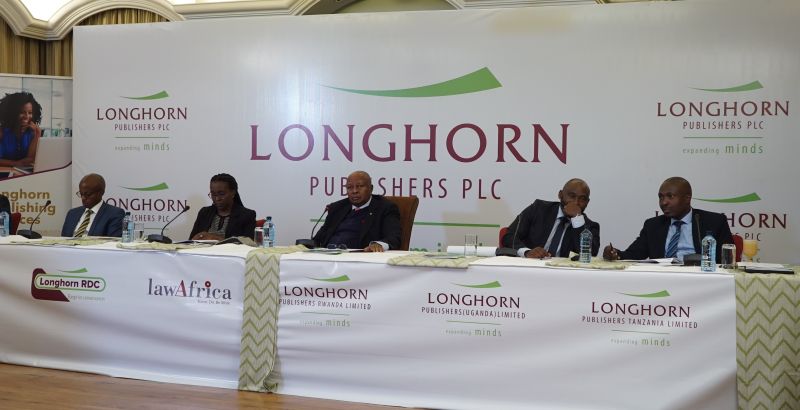
Longhorn Publishers is the biggest indigenous educational publisher in East Africa: the company behind many of the textbooks and storybooks Kenyan schoolchildren use.
It started in 1965 as the local arm of Britain’s Longman, passed into Kenyan hands in 1993, and listed on the NSE in 2012.
Its fortunes depend heavily on government decisions about the school curriculum and textbook purchases, and the last two years show how violently they can swing: revenue fell 56% in the year to June 2025, then nearly doubled in the following half year. Here’s the full picture.
History and Founding Story
Longhorn began in May 1965 as Longmans of Kenya, a wholly owned subsidiary of Longman Group International of the United Kingdom. In December 1969 it changed its name to Longman Kenya Limited.
In the early 1990s the education minister banned the importation of textbooks, which forced publishers to produce locally and moved the market in favour of local firms.
In 1993, Longman UK sold its remaining 40% stake to Kenyans, and the company became Longhorn Kenya Limited, which today describes itself as wholly owned and run by Kenyans.
Longhorn then built a regional business around schoolbooks. It set up a Ugandan subsidiary in October 1995, a Tanzanian one in May 2005, and entered Rwanda in 2009 and 2010.
In 2007 it launched its Sasa Sema series of schoolbooks. It also bought two Tanzanian publishers, Apex Publishers and Delah Publishers, the latter for KSh12.5 million in intellectual property rights and stock.
At the time, sales outside Kenya made up about a third of revenue, and Tanzania offered stable growth because its curriculum changes less often than Kenya’s.
Group revenue more than doubled, from KSh527 million to KSh1.1 billion, in the year to June 2011, driven by textbook sales.
The company listed on the NSE by introduction on 30 May 2012, and soon after took the name Longhorn Publishers (it became Longhorn Publishers PLC in 2018).
Its shares had been trading over the counter, and the OTC trading was suspended to make way for the listing. The listing raised no new money.
The recent history has been difficult: Kenya’s shift to a new curriculum (the competency based curriculum) and delays in government book purchasing gutted revenue in 2025.
Core Business Lines / Revenue Streams
Longhorn earns most of its money by developing, printing, and selling books for schools, and it is now adding digital products.
- Educational publishing (the core business): Textbooks, workbooks, and teacher guides for primary and secondary schools, plus reference books such as atlases, children’s literature, and tertiary titles. Titles have to be approved by the curriculum authority (in Kenya, the Kenya Institute of Curriculum Development), so approvals for a new curriculum grade can drive revenue.
- Government and private school sales: Government purchasing is a large and lumpy source of revenue, and private schools are the other main customers.
- Regional markets: Subsidiaries in Uganda, Tanzania, Rwanda, Cameroon, and the Democratic Republic of the Congo, with partnerships in Zambia and Malawi. Title approvals in Uganda (51 secondary titles) and the DRC (9 titles) were highlighted in earlier results.
- Digital and e-commerce: Kalamu, an AI powered e-learning platform with learning management tools; Mybidhaa, an online store for books and stationery; and a plan to roll out 50,000 digital learning devices.
Because the business is tied to school terms and government purchasing, the second half of the financial year (which runs from July to June) is usually stronger than the first.
Competitive Position in Its Industry
Longhorn calls itself the leading publisher of educational and creative books in East and Central Africa, and as the only listed publisher on the NSE it is the main public market proxy for the sector.
Among its rivals are well known names such as the state owned Kenya Literature Bureau and Oxford University Press East Africa.
Its edge is its title list, its relationships with schools, and its ability to adapt quickly to curriculum changes, which it says it showed in the move to the competency based system.
The last few years have been a roller coaster. Between 2014 and 2019 the company reported steady profits (profit after tax of KSh185 million in the year to June 2019, and a final dividend of KSh0.52 per share).
Revenue then collapsed when the pandemic and curriculum uncertainty hit, recovered strongly (first half revenue up 233% to KSh672 million in the half to December 2021), and hit KSh1.52 billion in the year to June 2024.
Then it fell 56% to KSh672.1 million in the year to June 2025, because of delayed government procurement and curriculum uncertainty, and the group lost KSh261.4 million (a loss per share of KSh0.96). Operating costs were cut 20%.
READ ALSO:Inside the NSE: WPP Scangroup (SCAN)
A recovery has started. In the six months to December 2025, the loss narrowed to KSh11 million, which Kenyan Wall Street called the best half year since the pandemic.
Gross profit more than doubled to KSh239.7 million and the gross margin rose to 45.8% from 40.5%. Simon Ngigi became chief executive on 1 October 2025.
Ownership Structure
Longhorn is controlled by no single owner, which is unusual for a company in this series. Based on Simply Wall St’s February 2026 breakdown, the main holders were:
- Pacific Futures and Options Limited: 12.9% (35.0 million shares).
- Francis Nyammo: 5.88% (16.0 million shares).
- Halifax Capital Corporation Limited: 5.81% (15.8 million shares).
- Kamami Investments Limited: 1.14%, and a handful of smaller holders. The top nine shareholders own 28.5% of the company.
- Other holders: Individual insiders hold about 7.6%, private companies about 20.9%, and the general public about 71.5%.
There are about 272 million shares in issue. There is no government stake and no foreign parent, which is a legacy of the 1993 sale of the last Longman shares to Kenyans.
A wide public holding means the company can be traded, but it also means nobody has an obvious interest in pushing through large changes.
Why It’s Listed on the NSE Specifically
Longhorn’s listing in 2012 was a listing by introduction. No new shares were sold and no capital was raised.
Instead, the company, which already had a wide base of Kenyan shareholders from the 1993 buyout and had been trading over the counter, moved its shares onto the regulated exchange. NIC Securities advised on the transaction.
The reasons were liquidity and visibility. Moving to the NSE gave existing owners a proper market to trade in, gave the company a public price and disclosure discipline, and let it say it was the only listed publisher in the region as it expanded into Uganda, Tanzania, Rwanda, and beyond.
In the recent downturn the listing has also meant that the market has seen every profit swing in real time.
For investors, it offers a rare way to hold exposure to African education publishing, with the caveat that the stock is tiny and hard to trade.
Current Stock Price
The most recent figure I found is about KSh3.28 a share, implied by Simply Wall St’s market capitalisation of KSh893.6 million on 13 February 2026 (272.4 million shares) and consistent with the value of one large holder’s stake.
In December 2025 the market value was about KSh804 million, or roughly KSh2.95 a share. Those are derived figures, not a direct quote, and I did not find a price after February 2026, so check the live price.
The stock is among the least liquid on the exchange: indicative trading liquidity over the twelve months to early February 2026 was only about US$82,500 (around KSh10.6 million), so even a small order can move the price.
Share prices move daily. For a live quote, check the NSE’s official market data page or a licensed brokerage platform before making any decisions.
How to Buy Longhorn Publishers Shares
You don’t need to be in Kenya to buy LKL shares; it can be bought locally or from abroad:
- Open a CDS (Central Depository System) account. This is Kenya’s electronic share registry account, required to hold any NSE listed stock. It’s opened through a licensed stockbroker or investment bank.
- Choose a licensed NSE stockbroker or investment bank. Examples include firms like Standard Investment Bank, AIB-AXYS Africa, Genghis Capital, and Faida Investment Bank. A full list of licensed trading participants is available on the NSE website.
- Fund your trading account via bank transfer, mobile money (M-Pesa is widely supported), or card, depending on the broker.
- Place an order for LKL through the broker’s trading platform, app, or by instructing your broker directly. Because trading volumes are very low, use limit orders and be patient.
- For non resident and diaspora investors, several online platforms (such as mystocks.africa and similar cross border brokerages) let you open an account remotely, fund it in USD or your local currency, and buy NSE listed shares like LKL without needing an in country presence, though you should confirm licensing and custody arrangements before using any platform.
- Hold and track. Shares are held electronically in your CDS account. Do not expect dividend income for now: the group made a loss in the year to June 2025, and the last dividend I could confirm was KSh0.52 per share for the year to June 2019. I did not find any later payout.
This profile is for informational and editorial purposes and is not investment advice. Stock prices, especially, change constantly, so always verify current figures with the NSE or a licensed broker before making any investment decision. Other figures reflect the most recent publicly reported data as of 2026 and may change with new financial disclosures. Longhorn is a small, thinly traded company whose results depend on government purchasing decisions.



Leave a Reply