The Uptime Institute Tier Classification System provides the globally recognised standard for assessing data centre infrastructure reliability and fault tolerance.
Developed by the Uptime Institute, this framework categorises facilities into four progressive tiers (Tier I through Tier IV) based on topology, redundancy, concurrent maintainability, and fault tolerance.
Each tier defines expected availability, allowable downtime, and the infrastructure’s ability to withstand failures or planned maintenance without interrupting operations.
The system focuses on the site infrastructure layer, including power, cooling, and supporting systems, rather than IT equipment or software. Certification requires formal design review, construction validation, and operational demonstration.

Tier I: Basic Capacity
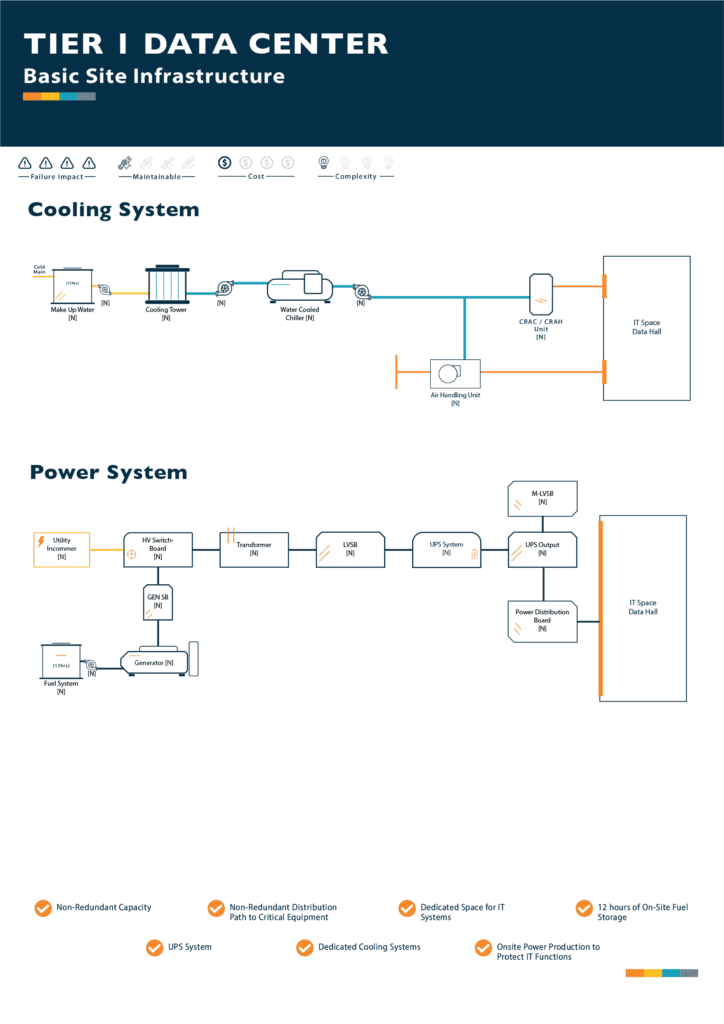
Tier I represents the simplest level of data centre infrastructure. It features a single, non-redundant path for power and cooling distribution, with no backup components beyond basic capacity.
- Key Characteristics
- Single active power and cooling path.
- No redundant capacity (N capacity only).
- Maintenance or component failure requires shutdown.
- Expected Availability: Approximately 99.671% (28.8 hours of unplanned downtime per year).
- Practical Implications Suitable for small organisations or non-critical applications with low tolerance for downtime. Cost-effective but vulnerable to both planned and unplanned interruptions. Most legacy or small enterprise facilities fall into this category.
Tier II: Redundant Components
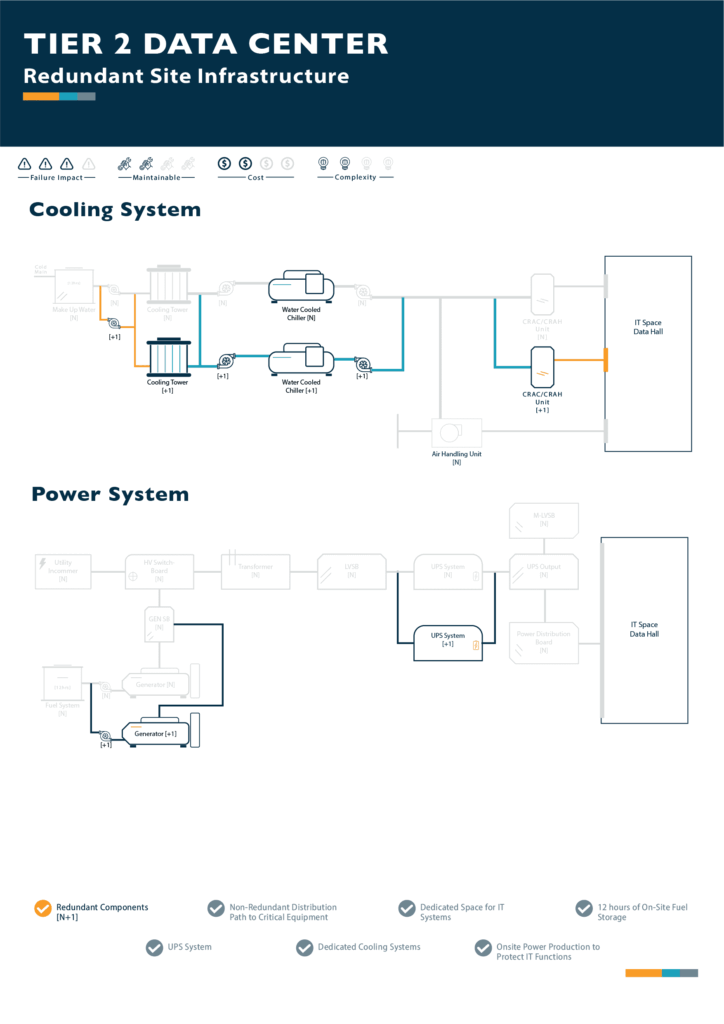
Tier II introduces component-level redundancy while retaining a single distribution path.
- Key Characteristics
- N+1 redundancy for critical components (e.g., extra UPS modules, chillers, or pumps).
- Single power and cooling distribution path.
- Planned maintenance still requires shutdown of the entire system.
- Expected Availability: Approximately 99.741% (22 hours of unplanned downtime per year).
- Practical Implications Offers improved resilience against single-component failures compared to Tier I. Appropriate for small to medium enterprises requiring moderate uptime but able to schedule maintenance windows. Downtime risk remains during maintenance activities.
READ ALSO:How Data Centres Ensure High Availability and Uptime
Tier III: Concurrently Maintainable
Tier III marks a significant step forward by enabling maintenance without service interruption.
- Key Characteristics
- Multiple independent distribution paths (at least two), with one active and one alternate.
- N+1 redundancy on critical components.
- Concurrently maintainable: any single path or component can be taken offline for planned work without affecting IT operations.
- Fault tolerance is limited to single failures only.
- Expected Availability: Approximately 99.982% (1.6 hours of unplanned downtime per year).
- Practical Implications Widely adopted for mission-critical applications such as financial services, healthcare systems, and large enterprises. Allows routine maintenance and upgrades with zero planned downtime, significantly reducing operational risk.
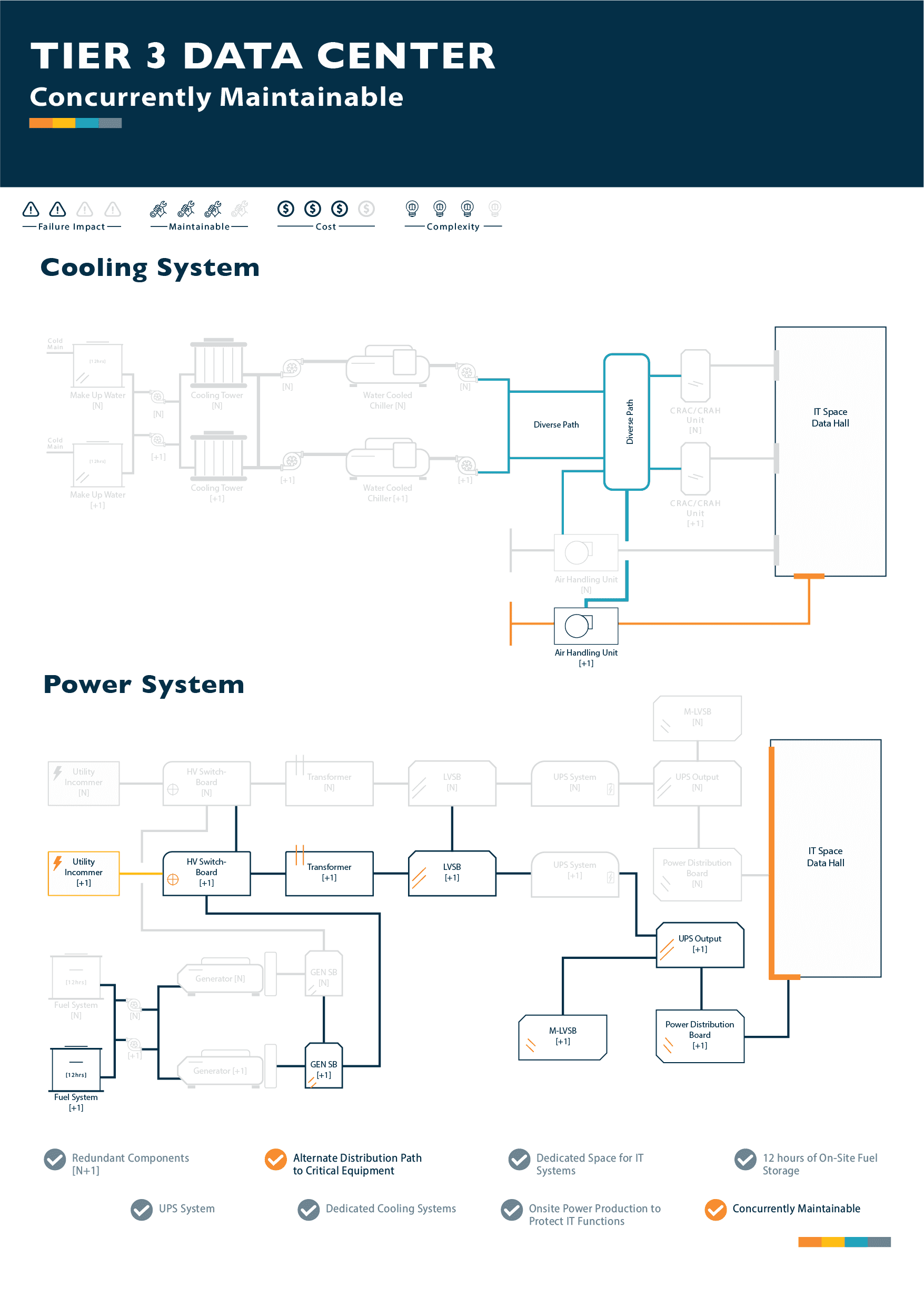
Illustration of Tier III infrastructure showing multiple distribution paths and N+1 component redundancy, enabling concurrent maintainability.
Tier IV: Fault Tolerant
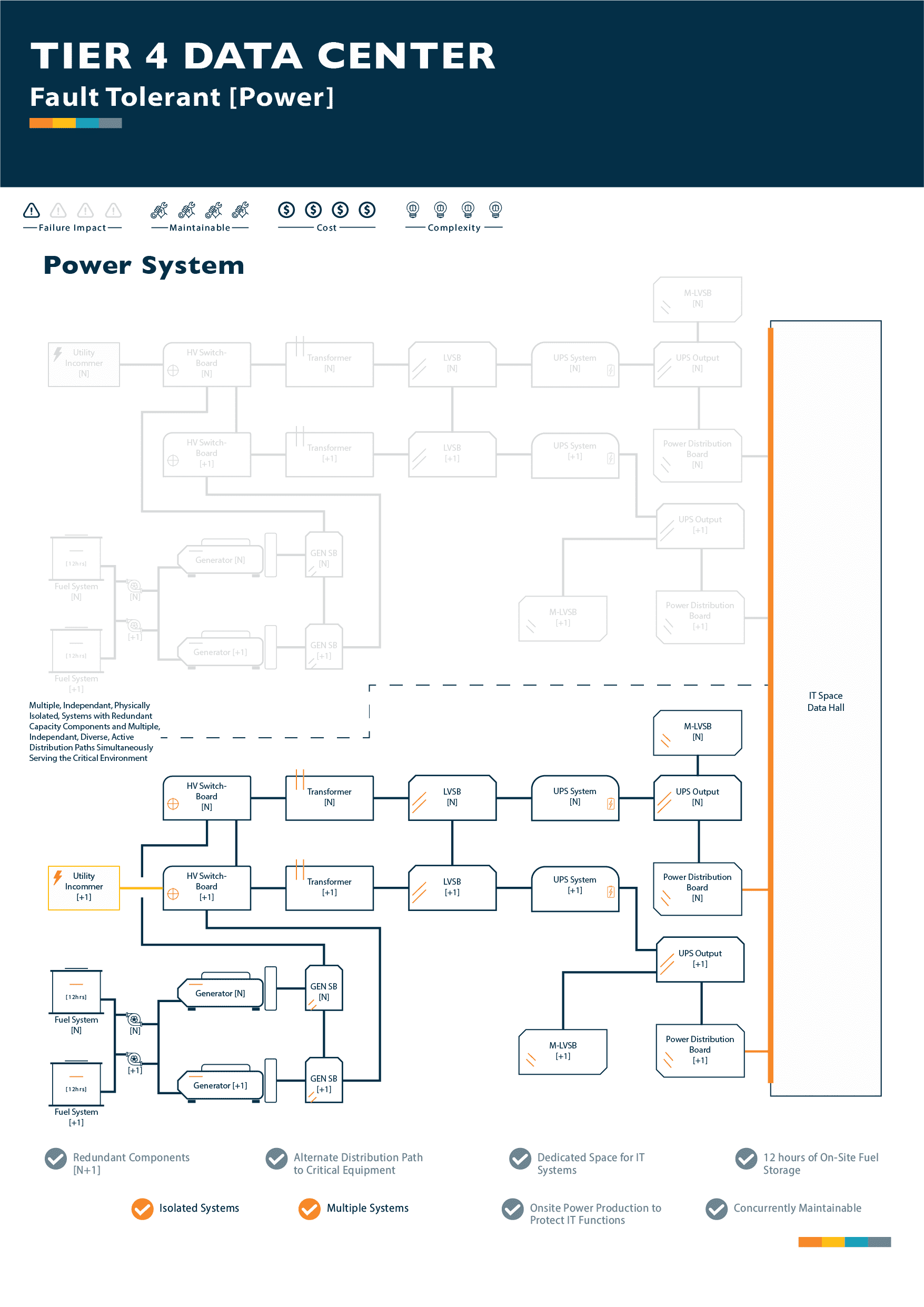
Tier IV delivers the highest level of reliability through full fault tolerance.
- Key Characteristics
- Multiple independent, active distribution paths with 2N (or higher) redundancy.
- Compartmentalisation to prevent cross-path failures.
- Can sustain at least one unplanned failure of any component or path without impacting operations.
- Fully fault-tolerant and concurrently maintainable.
- Expected Availability: Approximately 99.995% (0.4 hours of unplanned downtime per year).
- Practical Implications Reserved for the most demanding environments, including hyperscale cloud providers, global financial exchanges, and defence systems. Provides maximum protection against both planned and unplanned disruptions, though at significantly higher capital and operational costs.
Comparison of Tiers
The following table summarises the key differences:
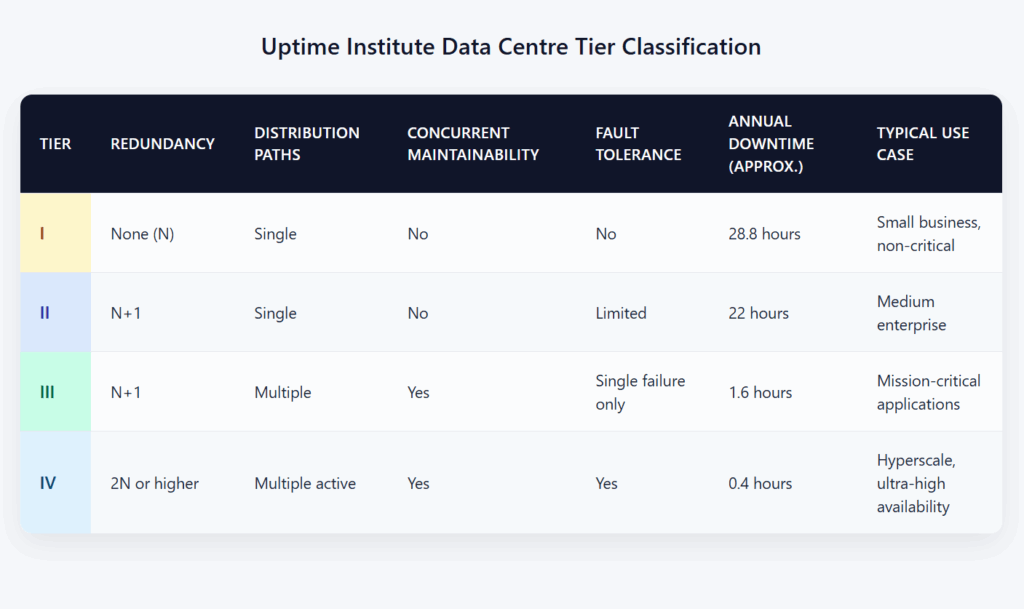
The Uptime Institute Tier system offers a clear, objective method to evaluate and compare data centre infrastructure reliability.
Selection of an appropriate tier depends on business requirements for availability, risk tolerance, budget constraints, and regulatory obligations. While higher tiers provide superior protection, they involve greater complexity and cost.
Organisations should align tier certification with actual operational needs and conduct regular audits to ensure sustained performance.
For authoritative guidance, consult the Uptime Institute’s official publications and certification processes.
Ronnie Paul is a seasoned writer and analyst with a prolific portfolio of over 1,000 published articles, specialising in fintech, cryptocurrency, climate change, and digital finance at Africa Digest News.





Leave a Reply