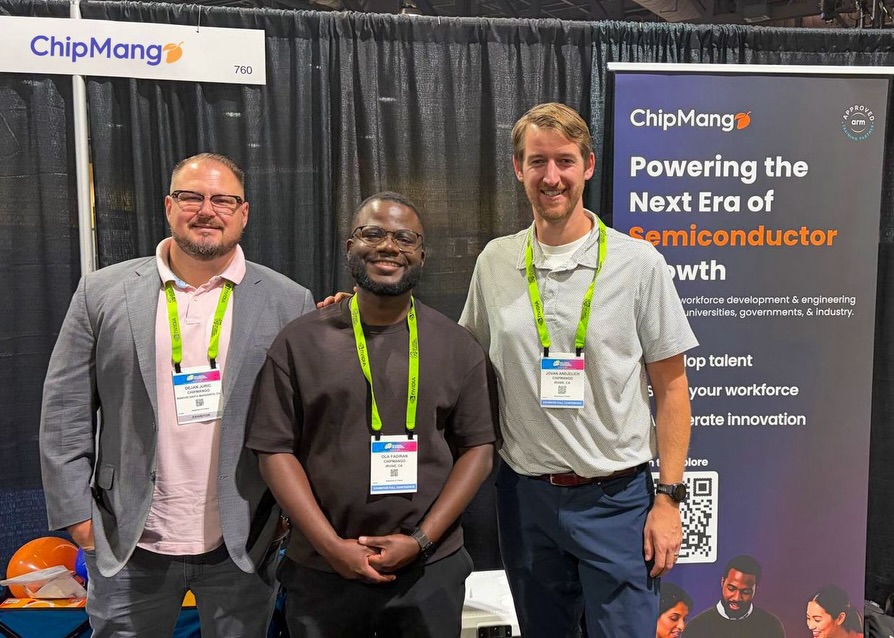
ChipMango, a California headquartered semiconductor technology company with major engineering operations in Lagos, Nigeria, has closed a $1.9 million seed round to expand its commercial chip design work and workforce development platform across Africa, the United States and Europe.
Atlantica Ventures, an Africa focused impact venture capital fund, led the round, with participation from DFS Labs, Kaleo Ventures, Madica, Trilinear Technologies, Malta Ventures and other strategic investors.
What the ChipMango Semiconductor Africa Funding Actually Targets
The ChipMango semiconductor Africa funding round is designed to do several things at once.
The company said it will use the capital to expand its engineering and product development capacity, take on new commercial chip design engagements, scale its AI native learning and workforce platform, and advance its edge AI and intelligent sensor technologies.
Founded in 2022 by Ola Fadiran and Jovan Andjelich, ChipMango operates a model that links training directly to commercial delivery, meaning engineers who come through its programmes are placed on real chip development projects for international clients rather than working through purely academic exercises.
The company focuses specifically on design and verification work rather than physical chip manufacturing, placing its engineers on projects that support clients who need additional technical capacity before designs move to fabrication plants.
The African Semiconductor Talent 2026 Opportunity
The African semiconductor talent 2026 pitch rests on a stark supply and demand mismatch. Africa has more than 10 million young people entering the labour market every year, yet only about 3 million formal jobs are created annually to absorb them.
At the same time, Deloitte estimates the global semiconductor industry will need more than one million additional skilled workers by 2030, as the industry, valued at $659.66 billion in 2026, continues expanding to meet demand from AI, connected devices and automotive technology.
ChipMango is betting that connecting these two trends, an oversupply of young talent on one side and an undersupply of skilled semiconductor workers on the other, can turn Africa’s demographic pressure into an economic opportunity rather than a persistent jobs gap.
Atlantica Ventures Founding Partner Anikó Szigetvári summed up the thesis behind the investment directly, saying the semiconductor industry’s binding constraint is no longer capital but people, and describing ChipMango as converting Africa’s deep engineering talent into world class chip design capability already proven through production grade work for global customers.
Why Chip Design Africa AI Workforce Development Matters Now
Chip design Africa AI workforce initiatives are gaining urgency as artificial intelligence drives unprecedented demand for advanced computing infrastructure.
Every AI system, from data centre accelerators to edge devices, ultimately depends on chips, and the engineers capable of designing, verifying and optimising those chips are in short supply globally.
ChipMango CEO Ola Fadiran framed this directly, saying the next era of AI will not be defined by software alone but will depend on who can design the chips, systems and intelligent hardware that power it, and that ChipMango is expanding access to those capabilities so more regions can help build the technologies shaping the future.
Currently, Africa contributes less than 1 percent to the global semiconductor market, with design and manufacturing capacity concentrated overwhelmingly in the United States, Europe and Asia.
ChipMango’s strategy does not attempt to compete on manufacturing, an area requiring enormous capital investment in fabrication plants, but instead targets the design and verification segment of the value chain, where skilled human talent matters more than physical infrastructure.
Inside the ChipMango Atlantica Ventures Investment
The ChipMango Atlantica Ventures investment also comes with meaningful partnership backing beyond capital.
ChipMango works with technology partners including Synopsys and academic institutions such as Ohlone College in California and the Carl Emily Fuchs Institute for Microelectronics at the University of Pretoria in South Africa, helping bridge the gap between academic learning and commercial engineering practice.
The company has also been named an Arm Approved Training Partner, with Arm’s Director of Product Management for Training Services, Matt Rushton, saying the partnership will expand access to high quality, industry aligned training that helps engineers worldwide build practical skills in Arm technologies.
Expansion Plans in Malta and Rwanda
As part of its growth strategy, ChipMango plans to establish a European Design Centre in Malta in partnership with Malta Ventures, giving it a foothold closer to European clients and talent networks.
In Africa, the company intends to develop semiconductor capability and workforce initiatives in Kigali, Rwanda, focused on semiconductor engineering, workforce development and AI infrastructure, extending its footprint beyond its existing Lagos operations into East Africa’s growing tech ecosystem.
What This Signals
ChipMango’s raise is a small round by global semiconductor standards, but its significance lies less in the dollar amount and more in what it represents, a bet that Africa’s chip industry opportunity lies not in competing on capital intensive manufacturing but in building the specialized human capital the global industry desperately needs.
If ChipMango’s model of pairing training directly with commercial delivery proves scalable, it could establish a template other African tech talent platforms look to replicate across adjacent high skill industries facing similar global labour shortages.


Leave a Reply