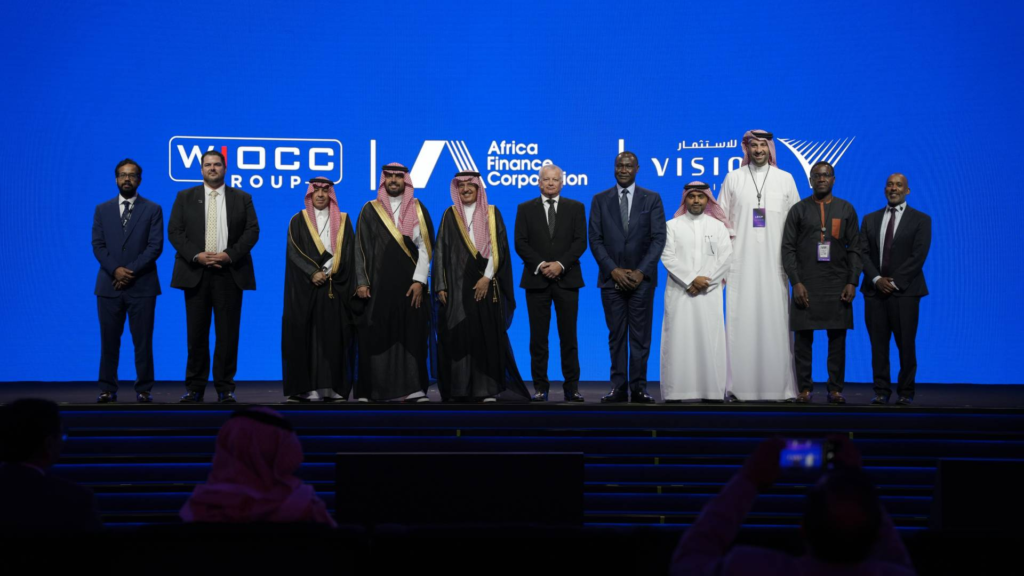
WIOCC Group has signed a Shareholder Subscription Agreement with Africa Finance Corporation and Saudi Arabia’s Vision International Investment Company, through which the two investors will make a combined $300 million investment in the pan African carrier neutral infrastructure platform.
The agreement was signed on September 1, 2026 at the LEAP Global Technology exhibition in Riyadh, giving WIOCC fresh capital to accelerate data centre deployment, expand its terrestrial fibre network and invest in new subsea cable assets across the continent.
What the WIOCC AFC Digital Infrastructure Africa Deal Actually Funds
The WIOCC AFC digital infrastructure Africa investment is earmarked for three specific priorities.
WIOCC Group CEO Chris Wood said the capital will let the company accelerate data centre deployment and consolidation, expand the continent’s open access terrestrial fibre footprint, and invest strategically in new subsea assets, all aimed at strengthening Africa’s digital infrastructure platform and improving connectivity between the continent and key international markets.
That three pronged focus, fibre, data centres and subsea cables, reflects the layered nature of digital infrastructure, where a gap in any single layer can bottleneck the whole system regardless of how strong the other two are.
Sizing Up the WIOCC $300 Million Investment 2026
The WIOCC $300 million investment 2026 arrives at a moment when demand for cloud computing, artificial intelligence and digital services is climbing quickly across African markets.
According to the International Telecommunication Union, only about 35.7 percent of Africa’s population was using the internet in 2025, compared with a global average above 73 percent.
That gap represents both a development challenge and a clear growth runway for infrastructure providers like WIOCC, since expanding connectivity to underserved populations requires exactly the kind of fibre, data centre and subsea investment this round is funding.
AFC President and CEO Samaila Zubairu framed the investment in terms that go beyond WIOCC itself, arguing that the Africa being built must be connected, competitive and positioned to create value from the digital economy rather than only consume it.
READ ALSO:CardinalStone Secures $76 Million in First Close for Second West African Growth Fund
He drew a direct comparison to physical infrastructure, noting that just as transport corridors enable trade and energy networks power industry, fibre, data centres and subsea cables have become essential infrastructure for growth, innovation and AI.
Africa Open Access Fibre Data Centres and Why the Model Matters
Central to WIOCC’s pitch to investors is its open access approach. Africa open access fibre data centres built on this model allow multiple telecommunications and technology companies to use shared infrastructure rather than each operator duplicating its own network.
In principle, that shared model improves network utilisation, lowers the cost of market entry for smaller providers, and makes it easier for businesses to reach customers across borders without every operator having to build parallel fibre routes or data centre capacity from scratch.
WIOCC now operates this open access platform in more than 30 African countries, making it one of the continent’s most extensive carrier neutral infrastructure networks.
WIOCC Group Vision Invest AFC and the Broader Shareholder Base
The WIOCC Group Vision Invest AFC agreement adds two significant new names to an already diverse shareholder register.
WIOCC’s existing backers include national telecom operators such as Uganda Telecom, Djibouti Telecom, Telkom Kenya, TelOne, Onatel, Mozambique’s TMcel and Zanzibar’s Zantel, alongside infrastructure players like Botswana Fibre Networks and Lesotho Communications Authority.
The International Finance Corporation and African Capital Alliance have also previously backed WIOCC’s development.
That mix of national telecom operators and international financial investors reflects how digital infrastructure in Africa is increasingly being built through coalitions that blend local market access with the patient capital needed to fund large, long horizon infrastructure projects.
For Vision Invest, the deal extends Saudi Arabia’s growing interest in African infrastructure investment, while for AFC, an institution that has invested more than $19 billion across 36 African countries since its founding in 2007, the WIOCC deal fits squarely within its established focus on infrastructure sectors including energy, transport and telecommunications.
What This Means Going Forward
For WIOCC, the $300 million injection provides the financial capacity to pursue infrastructure assets across a fragmented but fast growing digital market, at a moment when demand for AI ready connectivity is reshaping what African businesses and governments expect from their digital backbone.
Whether the investment translates into a meaningfully narrower connectivity gap will depend on how quickly WIOCC can deploy the new capital into actual fibre routes, data centre capacity and subsea links, and how effectively its open access model succeeds in drawing more service providers onto shared infrastructure rather than building their own from scratch.


Leave a Reply