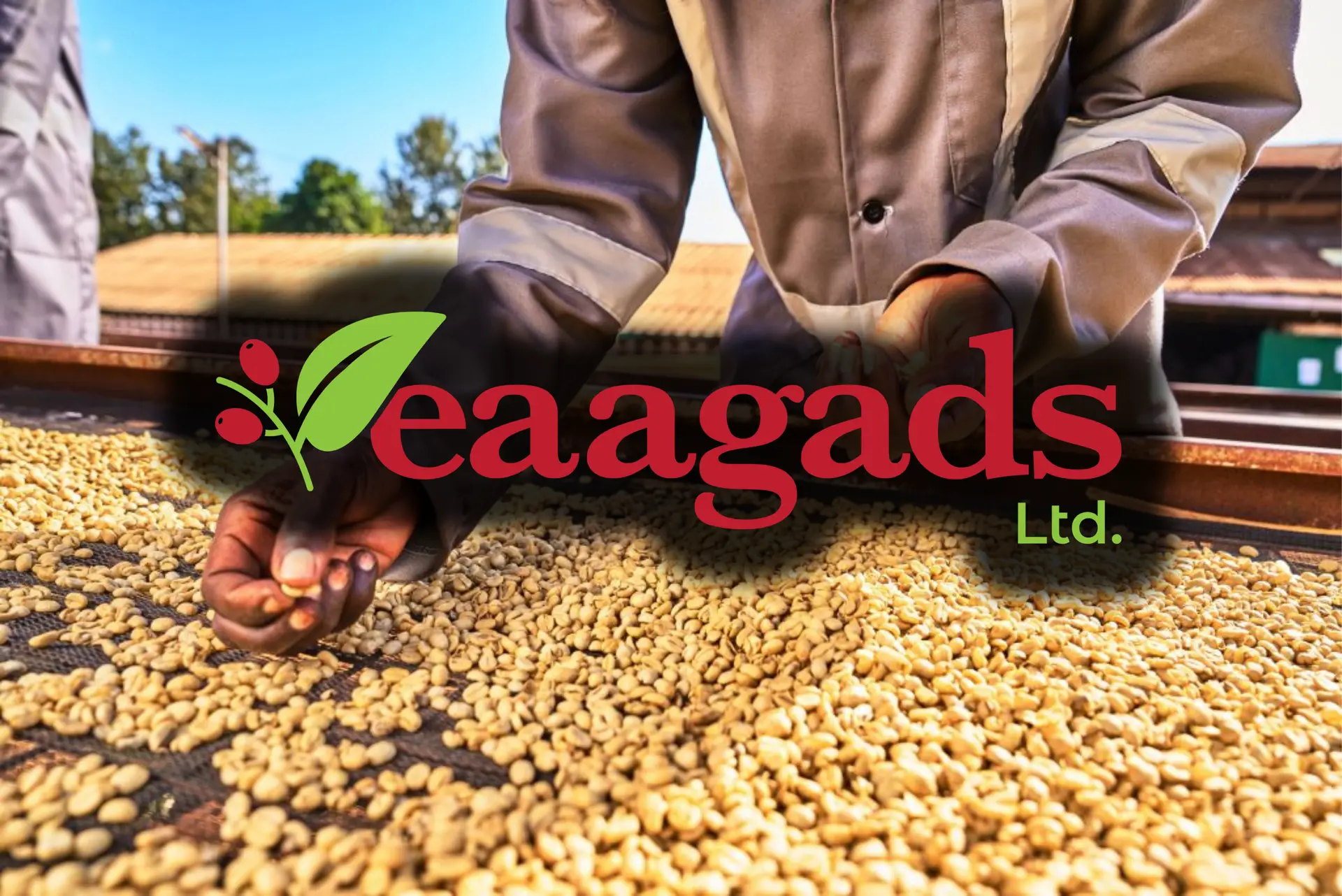
Eaagads traces its roots to 1946, when the company was incorporated as a private limited liability company to grow coffee on an estate in the highlands of Kiambu County, not far from Nairobi.
For decades it operated as a private grower, building up its Arabica coffee production on what is now 205 hectares of agricultural land.
The company became a public company relatively late compared with other agricultural names in this series: it was admitted to the Nairobi Stock Exchange in 2001, more than half a century after it was first incorporated, joining what is today the exchange’s Growth and Enterprise Market Segment, which caters to smaller companies.
That puts its listing decades after older agricultural peers like Sasini (1965) and Williamson Tea Kenya (1972), but still gives it a listing history stretching back a quarter of a century.
Eaagads has had a quieter corporate history than most companies in this series, without major mergers, rebrands, or regional expansions.
Its most notable brush with controversy came when its share price rallied sharply on investor speculation tied to Kenya’s booming real estate sector, speculation the company later had to publicly clarify was not supported by its actual business plans.
Today, the company remains focused squarely on its original purpose: growing, processing, and selling coffee, managed day to day by its controlling shareholder, Kofinaf Company Limited.
Core Business Lines and Revenue Streams
Eaagads is, by a wide margin, the most narrowly focused company in this series. Its entire business consists of:
- Coffee growing: cultivating high quality Arabica coffee across its Kiambu County estate, producing roughly 350 tonnes of coffee in a typical year, though output swings considerably with weather conditions from one season to the next.
- Coffee processing: pulping and milling the coffee at the company’s own facilities before it is sold.
- Coffee blending and sales: selling bulk coffee both to the domestic Kenyan market and for export internationally.
Because the business is built around a single crop grown on a single estate, Eaagads’ financial results are unusually sensitive to weather and global coffee prices from one year to the next.
In the financial year ended March 2022, for instance, net profit rose sharply even as coffee production and sales volumes actually fell, because the average price realized per kilogram climbed from about $5.52 to $6.90.
More recently, for its most recent reported fiscal year, the company posted revenue of roughly Ksh 257 million, down about 7 percent from the prior year’s Ksh 277 million, while net income rose sharply to about Ksh 27.6 million, more than double the prior year’s figure, illustrating just how differently revenue and profit can move at a company this exposed to commodity pricing swings.
Competitive Position in the Industry
Eaagads is a minor player by scale in Kenya’s coffee sector, competing against far larger agribusinesses covered elsewhere in this series, including Sasini, which grows coffee alongside tea, macadamia, and avocado, and against the thousands of smallholder farmers who supply the bulk of Kenya’s coffee crop through cooperative societies.
With a single estate and annual production in the low hundreds of tonnes, Eaagads is not a price setter in the Kenyan coffee market, it’s a price taker, directly exposed to whatever the global Arabica coffee market and the Nairobi Coffee Exchange auction system deliver in any given season.
What distinguishes Eaagads on the NSE isn’t its market position within the coffee sector, but its standing as one of the exchange’s smallest and most thinly traded listed companies.
Its stock has, at various points, shown dramatic price swings, including year to date gains ranking among the best performing stocks on the entire exchange in some periods, a pattern common among micro cap stocks where even modest trading volumes can move the price sharply.
Financial analysts covering the stock have flagged specific risk factors worth knowing: Eaagads does not have what would be considered a meaningful market capitalization by broader market standards, and some published risk scoring models have flagged an increased, though not alarming, risk profile typical of a small, single crop agricultural company.
Ownership Structure
Eaagads has one of the most concentrated and clearly documented ownership structures of any company in this series.
Kofinaf Company Limited, a company registered in Kenya, has held a controlling 61.74 percent stake in Eaagads for many years, a figure confirmed consistently across the company’s own annual reports.
Kofinaf itself is reported to be linked to Compagnie Internationale de Cultures, also known as Intercultures S.A., a Belgian agricultural investment company, extending Eaagads’ ownership chain back to European agricultural capital, in a pattern that echoes Kapchorua and Williamson Tea’s UK parent company.
READ ALSO:Inside NSE:Sasini PLC (SASN)
Beyond Kofinaf, two individual shareholders have held meaningful stakes in recent years: Vivienne Mary Rogerson with roughly 10.33 percent and Arbella Kathryn Deirdre Illingworth with roughly 10.21 percent, together holding about a fifth of the company between them.
The remaining shares are spread among a small number of other shareholders, with insiders collectively reported to own about a quarter of the company in recent data, and a notably small free float, the portion of shares genuinely available for public trading, reported at just over 3 million shares out of roughly 32 million outstanding, among the thinnest free floats of any company covered in this series.
Why It’s Listed on the NSE Specifically
Eaagads’ decision to list, and to stay listed despite its small size, reflects both its Kenyan operating base and the practical realities facing a small agricultural company:
- A genuinely Kenyan operating business: although its controlling shareholder traces back to Belgian agricultural capital, Eaagads’ entire operation, its coffee estate, processing facilities, and employees, sits in Kiambu County, Kenya, making the NSE the natural venue for public investors to access the business.
- Local incorporation and regulation: the company is incorporated in Kenya as a public limited company under the Companies Act and regulated by the Nairobi Securities Exchange and the Capital Markets Authority, placing it under Kenyan securities law.
- The Growth and Enterprise Market Segment fits a company this size: Eaagads trades on the segment of the NSE built specifically for smaller companies, with lighter listing requirements than the Main Investment Market, similar to Flame Tree Group’s listing structure, a fit given Eaagads’ modest market capitalization and single estate operations.
- A long standing public profile despite its size: having been listed since 2001, Eaagads has maintained public reporting and governance obligations for roughly a quarter century, giving Kenyan investors a way to hold a direct stake in a single estate coffee business that would otherwise be entirely privately held.
Current Stock Price
As of October 7, 2026, EGAD was quoted around Sh28.50 on the Nairobi Securities Exchange, giving the company a market capitalization of roughly Ksh 920 to 930 million, placing it firmly among the smaller companies on the exchange.
The stock’s 52 week range has run from about Sh16.50 to Sh37.00, a wide band that reflects just how volatile this particular stock can be.
The company declared a first and final dividend of Ksh 3.00 per share for the 2026 financial year, with a record date of June 26, 2026, and a payment date of August 31, 2026.
Given Eaagads’ small size, thin trading volumes, and exposure to volatile coffee prices, treat this figure as a historical snapshot rather than today’s number, and check the live quote through the NSE website, your broker’s trading platform, or a data source such as African Markets or myStocks before making any decisions.
How to Buy Eaagads Shares
Buying EGAD shares follows the standard process used across the Kenyan market, with extra caution warranted given the stock’s size and limited liquidity:
- Open a CDS account. A Central Depository System (CDS) account holds your shares electronically. You can open one through the Central Depository and Settlement Corporation (CDSC), though most investors do this through a licensed stockbroker as part of onboarding.
- Choose a licensed stockbroker. You’ll need an NSE licensed brokerage, such as Faida Investment Bank, AIB-AXYS Africa, or Genghis Capital, to place trades. Most offer mobile or online trading platforms.
- Fund your trading account. Deposit money into the account linked to your broker, typically through bank transfer or mobile money, depending on what the brokerage supports.
- Place your buy order. Specify the ticker (EGAD), the number of shares, and your price, either a market order at the prevailing price or a limit order at a price you set. Given this stock’s small free float and history of volatile price swings, a limit order is strongly worth considering here to avoid an unexpectedly large price move on even a modest sized trade.
- Diaspora and foreign investor options. Kenyans abroad and foreign investors can buy EGAD shares too. Many Kenyan brokerages support remote account opening with certified identification, and some platforms allow USD settlement, letting diaspora investors trade without being physically present in Kenya.
- Track your holding. Once the trade settles, usually within a few business days, the shares reflect in your CDS account. You can follow price movement, dividend announcements, and corporate actions through your broker’s platform, the NSE website, or financial data sites carrying live NSE quotes. Given how thinly traded this stock is, it’s worth paying close attention to trading volumes, not just price, before placing an order.
As with any equity investment, and especially one this small, this concentrated in a single crop, and this thinly traded, share prices can go down as well as up, sometimes sharply. This isn’t financial advice. It’s worth doing your own research, or speaking with a licensed financial advisor, before buying.



Leave a Reply