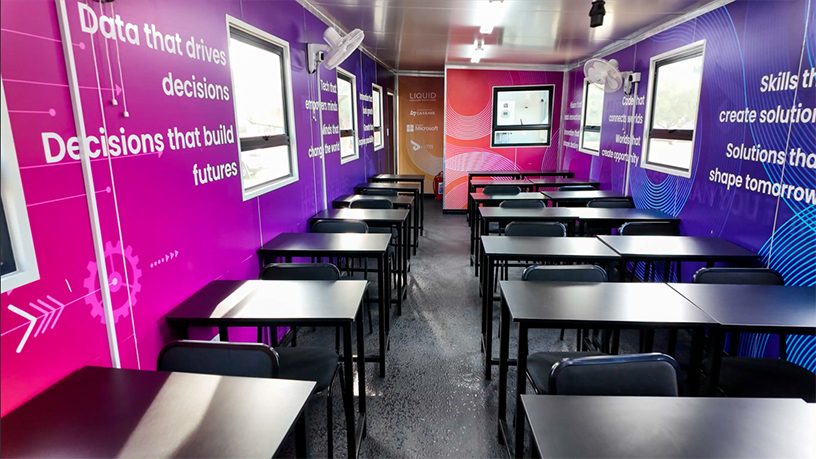
The Liquid Intelligent Technologies Microsoft Mobile Digital Lab in South Africa has been launched through a collaboration between Liquid Intelligent Technologies, Microsoft, and the South African Department of Communications and Digital Technologies.
It is hosted at the Royal Bafokeng Institute in Phokeng and built around a simple but powerful premise: if underserved communities cannot easily reach digital training, bring the training to them.
The facility is solar-powered, a deliberate design choice that ensures reliable infrastructure in areas where electricity supply and connectivity are inconsistent.
For learners in rural and peri-urban settings, that reliability is the difference between a programme that works and one that promises but cannot deliver.
What Learners Actually Walk Away With
The current three-month intensive cohort is built around developing “Fusion Developers” a hybrid skill set that bridges technical and functional expertise, positioning graduates to contribute across a range of business and technology environments.
Microsoft Power Platform training for underserved communities in South Africa sits at the heart of the curriculum, with learners earning internationally recognised certifications across three tracks:
- Power Platform Fundamentals
- Functional Consultant
- Power Platform Developer
Beyond the core certifications, the programme incorporates Microsoft 365, Teams, Copilot, and AI fluency training, supported by structured mentorship and professional development.
These are not theoretical competencies, as they are the building blocks of roles in digital operations, business analysis, and low-code application development that South African employers are actively seeking to fill.
Proof of Concept: The Mthatha Benchmark
The Mobile Digital Lab does not launch into the unknown. It builds on the demonstrable success of the Innovation Digital Skills Centre in Mthatha, Eastern Cape, which has trained 515 learners with a 96% pass rate and facilitated employment for 149 participants.
That employment conversion rate of more than one in four trained is the metric that matters most when evaluating whether digital skills programmes translate into real economic outcomes.
READ ALSO:
Ziaad Suleman, Senior Vice President and CEO of Cassava Technologies for South Africa and Botswana, pointed to Mthatha as proof that demand exists and can be met: strong uptake at the first centre justified the expansion to a mobile format that can serve communities beyond fixed infrastructure.
How Public-Private Partnerships Are Closing Digital Skills Gaps in South Africa
The Phokeng initiative is a textbook case of how public-private partnerships are closing digital skills gaps in South Africa.
Government provides policy alignment and institutional legitimacy. Microsoft contributes curriculum, certifications, and technology access.
Liquid Intelligent Technologies brings deployment capability and infrastructure expertise. The Royal Bafokeng Institute provides community trust and a learning environment embedded in the local context.
Neither party could replicate this outcome independently. A government programme without private sector technology partnerships risks delivering outdated training.
A corporate initiative without government coordination and community anchoring risks bypassing the communities that need it most.
The model works because each partner brings what the others cannot.
The Solar-Powered Digital Skills Centre as Infrastructure Thinking
The solar-powered digital skills centre model for rural South Africa is more than an energy solution.
It acknowledges that digital inclusion cannot wait for grid expansion, and that connectivity and power reliability are prerequisites for any meaningful training programme to function.
By baking energy resilience into the facility design, the programme removes one of the most common points of failure in rural digital initiatives. Learners show up knowing the lab will work.
That reliability is foundational to building the consistent attendance and completion rates that produce the outcomes Mthatha demonstrated.
The Bigger Question and the Answer Taking Shape
Can AI and Microsoft Power Platform training create new career pathways for youth in underserved South African communities?
The evidence from Mthatha says yes. The architecture of the Phokeng Mobile Digital Lab says the model can scale.
And the 149 employed graduates say the labour market is ready to absorb these skills when they are properly certified and practically grounded.
Overview
Liquid Intelligent Technologies South Africa: Liquid Intelligent Technologies provides fiber connectivity, cloud, cybersecurity, satellite and digital infrastructure services across South Africa and the broader African market.
Digital skills training South Africa: South Africa’s digital-skills ecosystem includes coding academies, telecom-backed training programs, ICT hubs and public-private initiatives focused on youth employment and digital inclusion.
Microsoft digital inclusion Africa: Microsoft supports digital inclusion in Africa through cloud access, AI skilling, connectivity, startup support and education partnerships.
Solar powered digital lab Africa: Solar-powered digital labs are off-grid ICT learning centers that combine renewable energy with internet-enabled education infrastructure to expand digital access in underserved African communities.


Leave a Reply