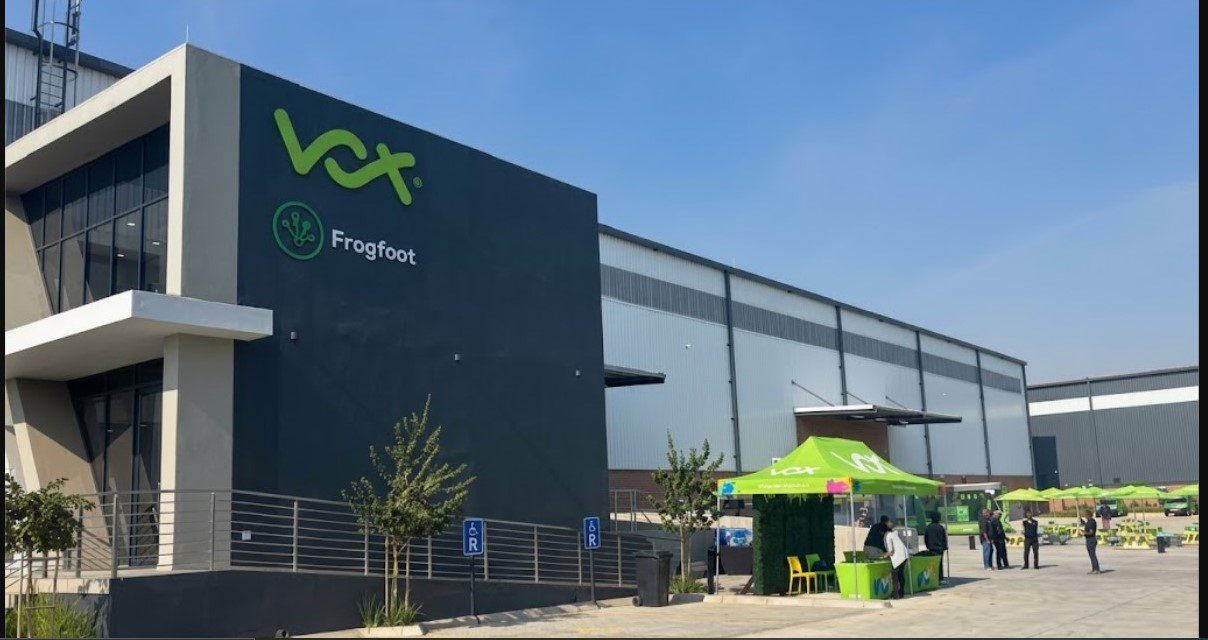
Frogfoot Networks, Vox and prepaid fibre brand Hypa have secured a major equity and debt funding transaction that values the combined businesses at R14.4 billion, capital the companies say will let them quadruple their annual fibre rollout and push aggressively into South African townships.
The deal was announced on August 24, 2026, and combines R8.4 billion in new equity with roughly R6 billion in debt facilities arranged by RMB, the corporate and investment banking division of FirstRand.
What the Frogfoot Vox Fibre South Africa Deal Actually Involves
The Frogfoot Vox fibre South Africa deal brings in new shareholders while restructuring who holds what across the group.
The largest incoming shareholder group is the DNI Consortium, made up of DNI 4PL Contracts, JSE listed Sabvest Capital, Masimong Group Holdings and Draper Gain International.
EM Three is entering as the third largest direct shareholder, and Metier Capital Growth Fund III is reinvesting alongside the new capital.
On the other side, RMB Ventures and the Mineworkers Investment Company are selling down their existing stakes as part of the transaction.
The new share subscriptions are structured so that no single shareholder ends up with majority control of Frogfoot or Vox.
Sabvest Capital’s piece of the deal illustrates the scale involved on its own.
The R5.5 billion investment holding company committed R754 million to acquire an 8.97 percent stake in both Frogfoot and Vox, based on the same R14.4 billion enterprise value underpinning the wider transaction.
Frogfoot R14.4 Billion Valuation in Context
The Frogfoot R14.4 billion valuation arrives despite the companies reporting a combined net loss after tax of R256 million and a negative net asset value of R665 million as of August 31, 2025.
That combination, a large headline valuation alongside current losses, reflects a growth bet rather than a valuation built on present day profitability. Investors are pricing the businesses on the strength of their existing fibre footprint and the addressable market still ahead of them, not on their current bottom line.
Frogfoot is South Africa’s fourth largest fibre network operator, providing fibre to the home, fibre to the business and fibre to the tower infrastructure, while Vox delivers fixed and wireless connectivity, voice, data, cloud and cybersecurity services to businesses, public sector customers and households.
The Township Opportunity Driving the Investment Case
South Africa township fibre connectivity is the central thesis behind this raise. Frogfoot CEO Abraham van der Merwe has framed the country’s affluent suburban market, roughly 4.5 million households, as largely saturated after nearly a decade of fibre rollout.
Townships and lower income areas, by contrast, represent an estimated 12 to 15 million households that remain largely untapped.
READ ALSO:How Standard Bank and Home Affairs Are Bringing Smart ID Services Closer to Rural Communities
With the new capital, Frogfoot plans to quadruple its annual home connection rate from around 80,000 to 360,000 within the next 12 months, with rollout concentrated in these underserved communities.
The expansion is expected to create more than 5,000 direct jobs in the areas where new infrastructure gets built.
Van der Merwe described the logic in blunt terms, pointing out that passed homes, the physical fibre infrastructure reaching a household, are an asset nobody can easily replicate once laid, meaning whichever operator reaches a township first effectively sets the pricing benchmark that competitors then have to beat.
Hypa’s Role in Reaching Lower Income Households
Hypa Prepaid Fibre South Africa is the retail arm most directly aimed at the customers this expansion targets.
Launched by Vox in 2021 and operating across the Vuma Reach, Openserve and Frogfoot Rise networks, Hypa focuses specifically on prepaid fibre products designed for lower income households who may not want or qualify for long term contracts.
The funding round lands just two weeks after Frogfoot separately launched Frogfoot Leap, its own prepaid fibre service offering uncapped high speed internet without a long term commitment, a sign that the group is moving on multiple fronts at once to capture township demand through different product structures.
What This Signals for South African Fibre
Van der Merwe called the capital raise designed for societal impact at scale, tying the commercial expansion directly to digital inclusion goals.
The transaction reflects a broader shift already underway across South Africa’s telecom and financial sectors, where banks, retailers and now fibre operators are increasingly targeting the country’s large informal economy in residential township areas rather than continuing to compete for an already saturated suburban market.
For Frogfoot, Vox and Hypa, the coming 12 months will be the real test of the thesis behind this valuation, whether the group can actually execute a fourfold increase in connection speed while turning today’s losses into the kind of sustainable growth its new investors are betting on.


Leave a Reply