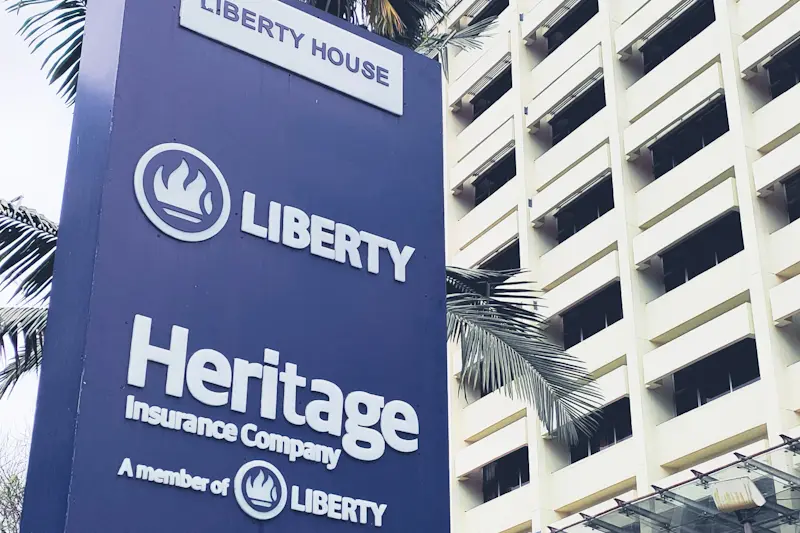
Liberty Kenya’s roots trace to two separate insurance lines that were later brought under one roof.
The general insurance side goes back to 1964, when the Kenya American Insurance Company was established, and to a 1976 merger between Norwich Union Fire and Legal & General that formed The Heritage Insurance Company.
The life insurance side began the same year, 1964, also as Kenya American Insurance Company, before it was renamed American Life Insurance Company (Kenya) Limited (ALICO Kenya) in 1987.
The modern group took shape through CfC Bank. In 2004, CfC Bank Holdings acquired ALICO Kenya and renamed it CfC Life Assurance.
In 2007, CfC Bank merged with Stanbic Bank Kenya to form CfC Stanbic Holdings, the largest banking merger in Kenya’s history at the time, bringing CfC Life and Heritage together under one conglomerate that also housed the newly combined bank.
In 2009, the group began separating its insurance and banking arms, demerging the insurance businesses into a standalone entity called CfC Insurance Holdings, with South Africa’s Liberty Holdings coming on board as the strategic investor.
CfC Insurance Holdings listed on the Nairobi Securities Exchange in 2011 through an introduction, meaning existing shares were admitted to trading rather than sold in a fresh public offering.
In 2012, the company renamed itself Liberty Kenya Holdings, aligning with its South African parent’s global brand. CfC Life followed in October 2014, becoming Liberty Life Assurance Kenya.
That same year, Liberty Kenya made local history as the first listed firm in Kenya to appoint a foreign national to its board under a special regulatory exemption.
The most consequential recent change happened far from Nairobi. Liberty Holdings itself, once independently listed on the Johannesburg Stock Exchange, was fully acquired by Standard Bank Group in a deal completed in February 2022, after which Liberty Holdings delisted from the JSE and became a wholly owned Standard Bank subsidiary.
That transaction means Liberty Kenya’s ultimate parent today is Standard Bank Group, the same institution that controls Stanbic Holdings, giving Standard Bank a foothold in both Kenyan banking and insurance.
More recently, in early 2025, the group sold its 60 percent stake in Heritage Insurance Tanzania, sharpening its focus on the core Kenyan market.
Core Business Lines and Revenue Streams
Liberty Kenya Holdings operates as a non operating holding company for two main underwriting subsidiaries, plus an investment arm:
- Heritage Insurance: general (short term) insurance covering motor, property, marine, engineering, and other non life risks. Heritage has become the larger revenue contributor since the Tanzania divestment, accounting for about 75 percent of group insurance revenue in 2024.
- Liberty Life Assurance Kenya: long term life insurance, including individual and corporate life cover, pensions, health insurance, and unit linked investment products. Liberty Life represents the larger share of group assets, around 57 to 60 percent, reflecting its exposure to investment linked business.
- CFC Investments: an investment services subsidiary offering asset management products alongside the group’s insurance lines.
- Bancassurance partnerships: a significant share of Liberty Kenya’s distribution runs through bancassurance agreements with Stanbic Bank Kenya, a relationship reinforced by the shared Standard Bank Group ownership, plus retail products like HeriAfya health insurance and funeral cover.
For the 2025 financial year, the group reported total earnings attributable to shareholders of Ksh 456 million, an 8.5 percent increase in insurance revenue, and total assets of Ksh 46.3 billion as of December 31, 2025. The board recommended a final dividend of Ksh 0.50 per share, totaling Ksh 268 million.
Competitive Position in the Industry
Liberty Kenya sits among Kenya’s established life and general insurers, built on two long standing brands (Heritage and Liberty Life) rather than competing purely on scale.
Both subsidiaries have earned AA+(KE) financial strength ratings from GCR Ratings, an affiliate of Moody’s, reflecting strong capitalization and a conservative, liquidity focused investment strategy weighted toward cash, deposits, and government securities.
Heritage’s AA+ rating has held since at least 2023, giving it a track record among Kenya’s higher rated general insurers.
Its most distinctive competitive asset is its bancassurance tie up with Stanbic Bank Kenya, which gives it a built in distribution channel that smaller, purely standalone insurers lack, and which analysts have flagged as having further room to grow (Stanbic’s contribution to Liberty’s bancassurance business was around 12 percent as of 2023).
Being folded into Standard Bank Group’s broader insurance programs also gives Liberty Kenya access to group level risk management and reinsurance support that a purely local insurer would not have.
The Kenyan insurance sector overall is also going through a period of consolidation, as the regulator tightens capital requirements and pushes weaker insurers to merge or exit.
Liberty Kenya’s ratings and its recent divestment from Tanzania position it as one of the better capitalized players navigating that shift, even though it is not among the largest insurers in the country by premium volume.
Ownership Structure
Liberty Kenya Holdings is majority owned by Liberty Holdings Limited of South Africa, whose stake has stood at approximately 73.5 percent in recent disclosures, up from roughly 57.7 percent a decade earlier.
Liberty Holdings itself is no longer an independently listed company: since the 2022 buyout, it has been a wholly owned subsidiary of Standard Bank Group, meaning ultimate control of Liberty Kenya now runs through Standard Bank, headquartered in Johannesburg.
The remaining shares, a little over a quarter of the total, trade on the NSE and are held by local institutional investors, pension funds, and individual retail shareholders.
READ ALSO:Inside the NSE: Sanlam Allianz Holdings Kenya (SLAM)
This ownership structure closely parallels Stanbic Holdings, the Kenyan bank also controlled by Standard Bank Group, giving the South African banking giant a coordinated presence across both banking and insurance in Kenya.
Why It’s Listed on the NSE Specifically
Liberty Kenya’s NSE listing reflects both its Kenyan operating history and the way its group structure was designed:
- Born from a Kenyan banking demerger: the company was created in 2009 specifically to hold the insurance businesses spun out of CfC Stanbic Holdings, a Kenyan incorporated and NSE listed group, so a Nairobi listing followed naturally from that corporate restructuring.
- Listing by introduction, not a fresh raise: CfC Insurance Holdings joined the NSE in 2011 through an introduction, meaning the shares were already held by CfC Stanbic’s existing shareholders and were simply admitted to separate trading, a mechanism only available on a domestic exchange where those shareholders were already active.
- Local incorporation and regulation: the group’s underwriting subsidiaries, Heritage and Liberty Life, are incorporated in Kenya and regulated by the Insurance Regulatory Authority, making the NSE the natural venue for public capital and disclosure.
- A deliberate multi country strategy by its parent: much as Standard Bank Group keeps Stanbic Holdings listed in Nairobi rather than consolidating everything into a single Johannesburg listing, Liberty Holdings (and now Standard Bank) has kept Liberty Kenya as a separately listed entity, preserving local investor access and Kenya specific governance even as ownership has consolidated at the top.
Current Stock Price
As of July 23, 2026, LBTY was quoted around Sh9.30 on the Nairobi Securities Exchange.
That compares with a close of Sh9.88 on June 11, 2026, and an opening price for the year of about Sh10.05, so the stock has drifted lower through much of 2026. The stock’s all time high was Sh12.20, reached in April 2025.
Liberty Kenya has a history of paying annual dividends, with the most recent full year payout at Sh0.50 per share for 2025. Prices move daily, so treat this figure as a snapshot rather than today’s number.
Check the live quote through the NSE website, your broker’s trading platform, or a data source such as African Markets or myStocks before making any decision.
How to Buy Liberty Kenya Holdings Shares
Buying LBTY shares follows the standard process used across the Kenyan market:
- Open a CDS account. A Central Depository System (CDS) account holds your shares electronically. You can open one through the Central Depository and Settlement Corporation (CDSC), though most investors do this through a licensed stockbroker as part of onboarding.
- Choose a licensed stockbroker. You’ll need an NSE licensed brokerage, such as Faida Investment Bank, AIB-AXYS Africa, Genghis Capital, or SBG Securities (also part of the Standard Bank Group family), to place trades. Most offer mobile or online trading platforms.
- Fund your trading account. Deposit money into the account linked to your broker, typically through bank transfer or mobile money, depending on what the brokerage supports.
- Place your buy order. Specify the ticker (LBTY), the number of shares, and your price, either a market order at the prevailing price or a limit order at a price you set. Orders match through the NSE’s electronic trading system.
- Diaspora and foreign investor options. Kenyans abroad and foreign investors can buy LBTY shares too. Many Kenyan brokerages support remote account opening with certified identification, and some platforms allow USD settlement, letting diaspora investors trade without being physically present in Kenya.
- Track your holding. Once the trade settles, usually within a few business days, the shares reflect in your CDS account. You can follow price movement, dividend announcements, and corporate actions through your broker’s platform, the NSE website, or financial data sites carrying live NSE quotes.
As with any equity investment, share prices can go down as well as up, and this isn’t financial advice. It’s worth doing your own research, or speaking with a licensed financial advisor, before buying.






Leave a Reply