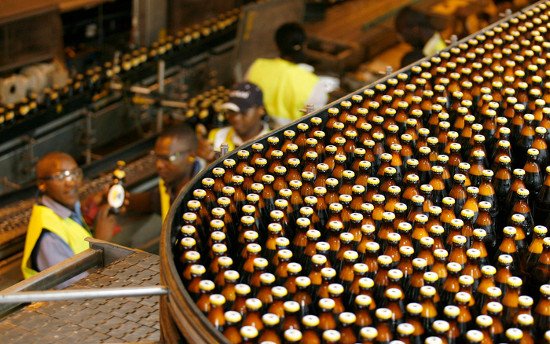
East African Breweries is a genuine East African institution: the maker of Tusker, the region’s most recognisable beer, and a company whose history stretches back over a century to a makeshift brewery in Nairobi.
It’s also, right now, in the middle of one of the most significant ownership changes in NSE history, as British drinks giant Diageo exits and Japan’s Asahi Group takes control. Here’s the full picture.
History and Founding Story
The company’s story begins on 8 December 1922, when Charles Hurst, George Hurst, and Henry Dowding registered Kenya Breweries Limited (KBL) and set up a makeshift brewery in Ruaraka, Nairobi, where the company’s headquarters still stand today.
Using a manual that came with equipment shipped from London, Charles Hurst, the company’s first brewer, heated a solution in a copper cup over a wood fire to brew the very first batch, delivered to the Stanley Hotel in Nairobi to decidedly mixed reviews.
The company was owned by the Dodd family of Kenya, and its founder, George Hurst, was later killed in an elephant hunting accident.
Growth came steadily through the following decades: KBL became a public company in 1934, and in 1935, it acquired Tanganyika-based Tanganyika Breweries.
The following year, the two companies merged, creating East African Breweries Limited, the group structure that has carried the business ever since. Regional expansion continued in 1959, when EABL acquired a financial holding in Uganda Breweries Limited, a brewer operating since 1946.
The company hit a major capital markets milestone in 1972, when it completed what was, at the time, the largest public share issue in Kenya’s history, offering 3 million ordinary shares at KSh18 each and raising its shareholder base to more than 23,000, a remarkable figure for that era.
In 2001, EABL cross-listed on the Uganda Securities Exchange (the region’s first cross-border listing), having already listed on the Dar es Salaam Stock Exchange, cementing its position as a genuinely regional company traded across all three East African bourses.
The next transformative shift came in 2000, when global drinks giant Diageo acquired majority control of EABL, a relationship that would define the company’s ownership for the next quarter century.
In 2022, EABL marked its centenary, a milestone few African listed companies can claim, and celebrated it by issuing a KSh11 billion medium term note, once again the largest public issue in Kenya’s history at the time.
Core Business Lines / Revenue Streams
EABL is East Africa’s largest beverage business, manufacturing, marketing, and distributing a portfolio spanning beer, spirits, and non-alcoholic beverages across the region.
- Beer (the historic core): Iconic brands including Tusker (the largest African beer brand within the wider Diageo portfolio, selling over 700,000 hectolitres annually in Kenya alone), along with Pilsner, WhiteCap, Bell Lager, Balozi, Senator, Guinness, and Hop House Lager, brewed and bottled through subsidiaries including Kenya Breweries Limited (KBL, 100% owned) and Uganda Breweries Limited (UBL, 98.2% owned).
- Spirits: A growing and increasingly important segment, including locally produced Uganda Waragi alongside internationally licensed Diageo brands like Johnnie Walker and Smirnoff, managed through United Distillers Vintners (Kenya) Limited (UDV Kenya), in which EABL holds a 46.32% stake, with the remainder historically held directly by Diageo.
- Non-alcoholic beverages: Malt-based and other non-alcoholic drinks, including Malta Guinness and Alvaro, diversifying revenue beyond alcohol.
- Regional operations: The group operates directly across Kenya, Uganda, and Tanzania (through a majority stake in Tanzania’s Serengeti Breweries, increased to 85% following a series of acquisitions in 2018 and 2020), with a depot presence in South Sudan and distribution partnerships extending into Burundi, Rwanda, and the Democratic Republic of Congo.
For the financial year ended 30 June 2026, this diversified regional footprint delivered standout growth: net sales rose 13% to KSh146.0 billion, with Tanzania posting 44% revenue growth, Uganda up 16%, and Kenya, still the group’s largest market, growing a steadier 5%, illustrating how the newer regional markets are increasingly driving the group’s overall momentum.
Competitive Position in Its Industry
EABL is unambiguously East Africa’s largest beer business, commanding leading market positions across Kenya, Uganda, and Tanzania, with a brand heritage and distribution network that smaller regional and international competitors struggle to match.
Its flagship brand, Tusker, carries genuine cultural weight in Kenya specifically, its slogan “Bia yangu, Nchi yangu” (“My beer, My country” in Kiswahili) reflecting a level of national brand identification few consumer products anywhere achieve.
The company’s recent financial performance has been exceptional. Full year 2026 results showed profit after tax surging 49% to KSh18.2 billion, on net revenue growth of 13% to KSh146.0 billion, with gross margins expanding to 42.6% from 42.0% the year before.
Half year results to December 2025 were similarly strong, with profit after tax up 38% to KSh11.2 billion on 11% revenue growth and 8% volume growth, a performance management described as among the company’s strongest in recent periods, driven by disciplined cost management, effective pricing, and a notable 30% jump in mainstream spirits volumes.
The company has also been actively deleveraging, cutting total debt by KSh6.2 billion during the 2026 financial year, which meaningfully reduced finance costs and helped profit grow faster than revenue.
That said, management has flagged real headwinds too: pressure on consumer discretionary spending amid persistent cost inflation, a KSh1.22 billion foreign exchange loss during the 2026 financial year, comparatively slower growth in the core Kenyan market, and the ongoing challenge of illicit, untaxed alcohol trade, which the company continues to engage regulators on directly.
Ownership Structure
EABL’s ownership structure is in the midst of its most significant transition since Diageo first took majority control in 2000, and the outcome will reshape who ultimately controls the company.
Diageo Kenya Limited (current controlling shareholder, transitioning to Asahi)
Diageo currently holds a 65% stake in EABL, having increased its position from 50.03% in late 2022 through a KSh22.7 billion transaction that bought out additional shares from local shareholders at a 39% premium.
READ ALSO:Inside NSE:Liberty Kenya Holdings (LBTY)
On 17 December 2025, Diageo announced it had agreed to sell its entire 100% shareholding in Diageo Kenya Limited, and therefore its full 65% EABL stake, to Japan’s Asahi Group Holdings, in a transaction valued at approximately US$2.3 billion in net proceeds to Diageo, implying an enterprise value for EABL of roughly US$4.8 billion (about KSh618.9 billion), a striking 17 times adjusted EBITDA.
The deal also includes Diageo’s separate 53.68% direct stake in UDV Kenya. The transaction is subject to regulatory approvals and was expected to complete in the second half of the 2026 calendar year.
General public and institutional shareholders
The remaining roughly 35% of EABL is held by the investing public across the NSE, Uganda Securities Exchange, and Dar es Salaam Stock Exchange listings, including local and foreign institutional investors, pension funds, and retail shareholders, the same base that sold its additional stake to Diageo back in 2022 and will see its counterparty change from Diageo to Asahi once the current transaction completes.
Notably, Asahi (known globally for brands like Asahi Super Dry and Peroni) will also enter into long-term licensing agreements with EABL to continue producing and distributing key Diageo brands, including Guinness, Johnnie Walker, and Smirnoff, in East African markets even after Diageo’s direct ownership ends, meaning the practical brand portfolio available to EABL is expected to remain largely intact through the ownership transition.
Why It’s Listed on the NSE Specifically
EABL’s NSE listing (on what was then the Nairobi Stock Exchange) predates most of the companies in this series by decades, and its 1972 share issue, the largest in Kenyan history at the time, was itself a landmark moment for the development of Kenya’s capital markets, dramatically widening the country’s base of retail shareholders.
As the company grew into a genuinely regional business, its 2001 cross-listing on the Uganda Securities Exchange (the first cross-border listing in East African capital markets history) and earlier Dar es Salaam Stock Exchange listing extended that same principle regionally, giving Kenyan, Ugandan, and Tanzanian investors alike direct access to a business whose beer brands and revenue streams span all three countries.
The NSE listing has continued to serve EABL well through major corporate events over the decades, including Diageo’s initial 2000 acquisition of majority control, subsequent capital raises like the 2022 centenary medium term note issuance, and now, the unfolding Diageo-to-Asahi ownership transition itself.
For Kenyan and regional investors, EABL’s NSE listing offers something genuinely distinctive: direct exposure to one of Africa’s oldest, most culturally resonant consumer brands, now entering a new chapter under a major Japanese multinational, with existing minority shareholders continuing to hold their stake through the change in control.
Current Stock Price
EABL’s share price has performed strongly, closing the 2026 financial year (30 June 2026) up 43% at KSh269, reflecting both the company’s own strong operating results and market enthusiasm around the pending Asahi transaction, which values the Diageo-held shares at KSh590.51 each, a figure well above where the stock has recently traded, suggesting the market may not yet be fully pricing in the deal terms for minority shareholders, or that the premium is specific to Diageo’s negotiated control stake rather than the open market price.
Share prices move daily, and EABL in particular may see continued volatility as the Diageo-Asahi transaction progresses toward completion and regulatory approvals are finalised. For a live quote, check the NSE’s official market data page or a licensed brokerage platform before making any decisions.
How to Buy East African Breweries Shares
You don’t need to be in Kenya to buy EABL shares; it can be bought locally or from abroad:
- Open a CDS (Central Depository System) account. This is Kenya’s electronic share registry account, required to hold any NSE listed stock. It’s opened through a licensed stockbroker or investment bank.
- Choose a licensed NSE stockbroker or investment bank. Examples include firms like Standard Investment Bank, AIB-AXYS Africa, Genghis Capital, and Faida Investment Bank. A full list of licensed trading participants is available on the NSE website.
- Fund your trading account via bank transfer, mobile money (M-Pesa is widely supported), or card, depending on the broker.
- Place an order for EABL through the broker’s trading platform, app, or by instructing your broker directly, specifying the number of shares or amount you want to invest.
- For non resident and diaspora investors, several online platforms (such as mystocks.africa and similar cross border brokerages) let you open an account remotely, fund it in USD or your local currency, and buy NSE listed shares like EABL without needing an in country presence, though you should confirm licensing and custody arrangements before using any platform.
- Hold and track. Shares are held electronically in your CDS account. EABL has a strong and growing dividend record: the total dividend for the 2026 financial year rose 59% to KSh12.70 per share (comprising a KSh4.00 interim dividend and an KSh8.70 final dividend), paid out directly to your linked bank account.
This profile is for informational and editorial purposes and is not investment advice. Stock prices, especially, change constantly, so always verify current figures with the NSE or a licensed broker before making any investment decision.
Other figures reflect the most recent publicly reported data as of 2026 and may change with new financial disclosures. The Diageo-Asahi ownership transaction remains subject to regulatory approval, so readers should check for the latest status before assuming it has completed.



Leave a Reply