Unga Group is Kenya’s only publicly listed flour miller and one of the country’s oldest companies, with roots stretching back to 1908.
It’s also been through one of the sharpest turnarounds in this entire series: a company that lost money for two and a half straight years, returned to profit in late 2024, and then saw its earnings per share leap sevenfold in a single reporting period. Here’s the full picture.
History and Founding Story
Unga’s origins trace back to 1908, when what would become Unga Limited was first formed, making it, alongside East African Breweries and BOC Kenya, one of the handful of truly century-old businesses in this series.
The company was formally incorporated in 1928, and over the following decades grew by acquiring a string of smaller milling and bakery businesses, including Kenya Grain Mills, Proctor & Allan, and Elliot Bakeries & Elianto, between 1929 and 2000.
Its Eldoret plant was established through the acquisition of Sun Flour Mills, adding to existing operations that would eventually also span Nakuru and Mombasa.
The modern Unga Group Limited structure was officially formed in 1987, when the business was renamed from its earlier identity as Mercat Limited, itself the historic name under which Unga Millers had operated.
The company’s next defining chapter came at the turn of the millennium: by 2000, Unga was in financial difficulty, posting losses that prompted it to seek a strategic partner.
That partner was Seaboard Corporation, a US-based agribusiness and shipping conglomerate, which invested in Unga Group in 2000 via a new entity, Unga Holdings Limited, acquiring a 35% stake in the operating businesses, with the remainder held through Unga Investments Limited, itself wholly owned by the publicly listed Unga Group Plc.
The following decades brought further strategic moves, including the 2002 formation (and 2017 closure) of Unga Millers Uganda, later redirected into a joint venture for fish feed production with Dutch animal nutrition company Nutreco, branded Tunga.
In 2015, Unga re-entered the bread market through its acquisition of Ennsvalley Bakery, a venture it would later exit in 2021, selling the bakery business to cold storage and logistics firm BigCold Kenya as part of a broader effort to refocus the group on its core milling and nutrition businesses after a period of significant profit decline.
Core Business Lines / Revenue Streams
Unga Group operates as a holding company with two core operating segments: human nutrition and animal nutrition and health, delivered through a set of wholly owned subsidiaries.
Human nutrition (the core engine)
Milling of maize and wheat for human consumption, producing wheat flour, sifted maize meal, porridge, spaghetti, pulses, and rice, through Unga Limited in Kenya (with mills in Eldoret, Nakuru, and Mombasa) and Unga Millers (U) Limited in Kampala, Uganda.
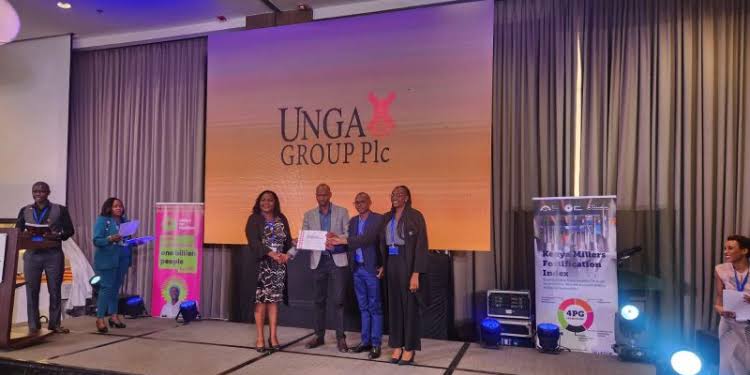
Unga has been recognised as the overall top performer at Kenya’s Millers Fortification Index Awards for multiple consecutive years, reflecting its focus on fortifying everyday staples like maize and wheat flour with essential nutrients for public health.
Animal nutrition and health
Manufacture of animal feed and mineral supplement products, along with distribution of animal health products, through Unga Farm Care (East Africa) Limited in Kenya, a segment that diversifies the group’s revenue beyond human food products alone.
Strategic partnerships
Beyond its wholly owned operations, Unga has pursued a number of partnership ventures to extend its reach, including the Unga-Nutreco fish feed partnership under the Tunga brand, an Unga-Egyptian Swiss partnership for spaghetti production, and various contractual milling partnerships across the Sub-Saharan region.
Investment holding structure
Unga Investments Limited serves as the group’s internal investment holding company, 100% owned by Unga Group Plc, which channels ownership of the operating subsidiaries.
Competitive Position in Its Industry
Unga Group holds a historically significant and still notable position in Kenyan food processing: it is the only publicly listed flour miller on the Nairobi Securities Exchange, giving investors a uniquely direct way to gain exposure to this specific, staple-food-driven segment of the Kenyan economy.
That position, however, has come under genuine and escalating competitive pressure.
READ ALSO:Inside the NSE: BAT Kenya (BAT)
In September 2026, Unga Group specifically flagged the entry of three new millers into Kenya’s wheat and maize flour market, warning that this had significantly disrupted competition in the staple-driven sector and triggered what it described as unsustainable pricing battles among rivals, battles the company said it had deliberately chosen not to engage in.
That competitive warning came even as Unga’s own underlying financial performance was recovering sharply: having swung from a KSh669.58 million net loss in the financial year to June 2024 to a KSh222.06 million net profit for the year to June 2025, and then posting a particularly dramatic rebound in the first half of the 2026 financial year (the six months to 31 December 2025), with net profit surging to KSh523.2 million from just KSh82.2 million a year earlier, a sevenfold jump in earnings per share, to KSh4.48 from KSh0.63, even as revenue grew a more modest 12% to KSh14.5 billion.
Much of that recent earnings turnaround has come from factors below the operating line rather than from revenue growth alone: falling interest rates cut finance costs by 53% to KSh106.2 million, operational efficiencies more than doubled operating profit to KSh746.8 million, and a 2025 sale of the company’s stake in packaging firm Bullpark Limited also contributed to an earlier period’s profit recovery.
Despite the improved profitability, the board has twice in recent periods declined to recommend a dividend, in both cases citing the need to conserve cash and rebuild working capital that had been eroded by the company’s earlier run of losses, a cautious stance management has paired with warnings about unfavourable weather conditions threatening key raw material supplies, and persistent currency, inflation, and global supply chain risks.
Ownership Structure
Unga Group is a privately founded, publicly traded company with a significant and long standing foreign strategic investor, alongside a notable local media sector cross-shareholding.
- Unga Investments Limited: Holds the operating subsidiaries on behalf of the listed parent, itself 100% owned by Unga Group Plc, forming the core of the group’s internal holding structure.
- Seaboard Corporation (through Unga Holdings Limited): A major strategic shareholder, having first invested in 2000 by acquiring a 35% stake in Unga Holdings Limited (the entity that held Unga Investments Limited at the operating level). At the Unga Group Plc listed company level, Seaboard’s effective shareholding has been reported at around 18.47%, reflecting its position as the group’s most significant single foreign strategic investor.
- Nation Media Group: A notable cross-shareholder, with Unga Group’s own corporate disclosures listing Nation Media Group, another prominent NSE listed company, among its recorded shareholders, an example of the kind of cross-ownership ties that appear periodically among Kenya’s older, longer established listed companies.
- General public and institutional investors: The remainder is held by the broader investing public, including local and foreign institutional investors, pension funds, and retail shareholders trading on the NSE.
Why It’s Listed on the NSE Specifically
Unga’s NSE listing reflects its status as one of Kenya’s oldest industrial companies, predating most of the privatisation-driven listings covered elsewhere in this series and instead growing organically alongside the development of Kenya’s formal capital markets over more than a century.
As a business fundamentally tied to staple food production, wheat and maize flour that forms a core part of the Kenyan diet, Unga’s public listing has historically given Kenyan investors a direct stake in a sector with genuine social and economic significance, distinct from banking, insurance, or energy.
The listing proved particularly important during the company’s early-2000s financial difficulties, providing the transparent, regulated framework within which Seaboard Corporation’s strategic investment and subsequent partnership could be structured and disclosed to the investing public.
More recently, as Unga has navigated a dramatic cycle of losses followed by recovery, its NSE listing has given investors ongoing visibility into both the severity of the earlier downturn and the specifics of the recent turnaround, information that would be far harder to access for a comparable privately held milling business.
For Kenyan investors specifically, Unga’s listing offers a genuinely distinctive proposition: it remains the only direct, pure-play route to publicly traded exposure to Kenya’s flour milling industry, even as new, unlisted competitors increasingly challenge its market position.
Current Stock Price
Unga Group’s share price has rallied substantially alongside its financial recovery.
Recent data put the stock at around KSh32.55, having gained 41.52% in the period measured, with a market capitalisation of roughly KSh2.5 billion.
That builds on an earlier rally: the stock had already gained 63.6% to reach KSh24.55 within one calendar year during its initial return to profitability, at the time one of the best performing counters on the entire NSE, trailing only a handful of other dramatic turnaround stocks like Uchumi, East African Cables, and HF Group.
Share prices move daily, and Unga Group in particular has shown substantial volatility tied closely to its swings between losses and profits in recent years.
For a live quote, check the NSE’s official market data page or a licensed brokerage platform before making any decisions.
How to Buy Unga Group Shares
You don’t need to be in Kenya to buy UNGA shares; it can be bought locally or from abroad:
- Open a CDS (Central Depository System) account. This is Kenya’s electronic share registry account, required to hold any NSE listed stock. It’s opened through a licensed stockbroker or investment bank.
- Choose a licensed NSE stockbroker or investment bank. Examples include firms like Standard Investment Bank, AIB-AXYS Africa, Genghis Capital, and Faida Investment Bank. A full list of licensed trading participants is available on the NSE website.
- Fund your trading account via bank transfer, mobile money (M-Pesa is widely supported), or card, depending on the broker.
- Place an order for UNGA through the broker’s trading platform, app, or by instructing your broker directly, specifying the number of shares or amount you want to invest.
- For non resident and diaspora investors, several online platforms (such as mystocks.africa and similar cross border brokerages) let you open an account remotely, fund it in USD or your local currency, and buy NSE listed shares like UNGA without needing an in country presence, though you should confirm licensing and custody arrangements before using any platform.
- Hold and track. Shares are held electronically in your CDS account. Note that despite its recent return to profitability, Unga Group’s board has twice declined to recommend a dividend in recent reporting periods, explicitly prioritising cash conservation and balance sheet rebuilding after prior years of losses, so check the company’s latest financial disclosures closely before assuming any income from the shares.
This profile is for informational and editorial purposes and is not investment advice. Stock prices, especially, change constantly, so always verify current figures with the NSE or a licensed broker before making any investment decision. Other figures reflect the most recent publicly reported data as of 2026 and may change with new financial disclosures.



Leave a Reply