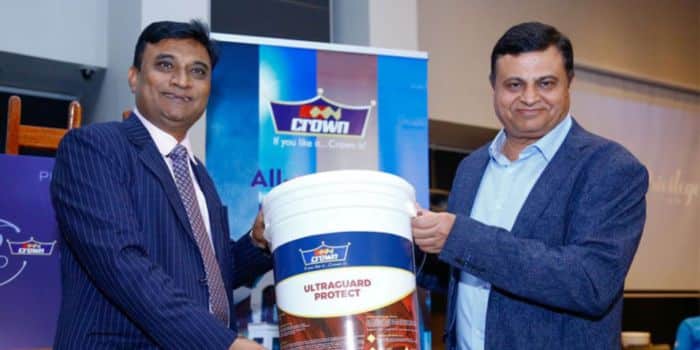
Crown Paints is the best known paint brand in Kenya and one of the few NSE companies that has been through a full cycle of boom, loss, and recovery in the last five years.
It lost money in 2023 and suspended its dividend, then nearly doubled its profit in 2025.
It also has one of the more layered ownership structures on the exchange, with a family led group, a cross-border holding company, and a rights issue that shifted the balance of control. Here’s the full picture.
History and Founding Story
Crown Paints began operating in Kenya in 1958 as The Walpamur Company (East Africa) Limited. In 1978 it was renamed Crown Paints and Building Products (K) Limited.
At the time, its main rivals were Berger Paints and Layland, and by 1986 Crown had overtaken Berger to become the market leader.
In 1992 Crown entered a partnership with Berger Paints Kenya to form Crown Berger Kenya Limited, and the combined company listed on the Nairobi Stock Exchange the same year.
Public trading in its shares began on 4 January 1993. Berger itself had gone through several name changes (it began as Robbialac Paints Kenya), so the 1992 merger effectively absorbed one of the oldest paint names in the country.
In 1998 the Charania family acquired Crown Berger Kenya, a change of control that has shaped the company ever since.
A 2004 partnership with PPG brought automotive paints into the range, and a string of certifications and brand awards followed in the late 2000s.
In 2012, after a resolution at its 55th AGM, the company dropped “Berger” from its name and became Crown Paints Kenya Limited, taking over Crown’s Tanzanian business and giving up the Berger brand in both Kenya and Tanzania. It later became Crown Paints Kenya PLC and marked its 60th anniversary in 2018.
The recent chapter has been turbulent. After a loss in 2023, the company suspended its dividend, and in around 2022 and 2023 it raised fresh capital through a rights issue of KSh711.8 million, selling 71.1 million shares at KSh10 each, a 72.2% discount to the then trading price of KSh36.
The Capital Markets Authority approved the offer and gave the major shareholders an exemption from takeover rules, so they could raise their stakes if smaller investors did not take up their shares.
Core Business Lines / Revenue Streams
Crown Paints manufactures and sells paints and related building products across several segments.
- Decorative paints: Emulsion, gloss, roof, wood finish, and textured paints for homes and commercial buildings, sold through dealers and its Crown Decor World showrooms. This is the largest and most visible part of the business.
- Industrial and automotive paints: Coatings for manufacturers and car refinishing, including products developed with partners such as PPG.
- Construction chemicals and sundries: Adhesives, sealants (including silicones launched with Wacker Chemie), fillers, primers, decorating sundries, PVA emulsion, and alkyd resins.
- Regional subsidiaries: Operations in Uganda, Tanzania, and Rwanda, which together contribute only about 6.2% of group revenue, so the business is overwhelmingly a Kenyan one.
The company makes more than 3 million litres of paint a month and employed 2,423 people in 2025. To cut its dependence on imports, it plans to build an emulsion binder and plastic injection moulding plant at Lukenya, near Athi River in Machakos County, at a cost of about KSh355 million.
Competitive Position in Its Industry
Crown Paints is widely described as East Africa’s leading paint company.
A company statement from 2010 put its share of the premium market at 65%, and it had a smaller share in the economy segment, though those figures are old and the market has become more competitive since.
Rivals include Basco Paints (maker of Duracoat, founded in 1976 and claiming East Africa’s largest paint factory by capacity), Kansai Plascon (which entered Kenya in 2017 by buying Sadolin), Galaxy Paints, Solai Paints, and several smaller makers. Crown is the only paint maker on the NSE.
The recent numbers show a recovery from a weak 2023. For the year to December 2025, group revenue grew 19% to about KSh16 billion, profit before tax rose to KSh1.40 billion from KSh787 million, and net profit was KSh948 million, up 74% from KSh544 million, with earnings per share of KSh6.66 against KSh3.82.
Management credited a stable shilling, which made imported raw materials cheaper, along with stronger demand and cost control.
Gross margin rose to 8.7% from 5.8%, according to the Business Daily, which noted that the company did not explain what lifted it.
Momentum continued in the first half of 2026: pre tax profit rose 25.5% to KSh688 million, though net profit grew only 11.2% to KSh486 million because the tax charge jumped 82%.
No interim dividend was declared. Paint is a business with heavy imported inputs, so the shilling and global raw material prices remain the main swing factors.
READ ALSO:Inside the NSE: East African Portland Cement (PORT)
Ownership Structure
According to Simply Wall St’s breakdown of the roughly 142 million shares in issue:
- Crown Paints and Building Products Limited: 48.4%, the largest holder, with 68.9 million shares.
- Beaumont Properties Limited: 22.4%.
- A holder listed as “Barclays PLC”: 18.3%, labelled as an institution. This label looks like a data error for Barclay Holdings, the Belize-based investor that a 2022 Business Daily report described as holding about 62% of the company at the time of the rights issue, so I’d avoid quoting this line without checking the NSE share register.
- Individuals and smaller holders: Several members of the Shah family, Mahendra Patel, John Ogango, and a number of companies each hold well under 1%. Individual insiders hold about 2.6%, and the general public about 7.7%. The company reported 3,197 shareholders in total.
The company’s own history says the Charania family acquired Crown Berger Kenya in 1998, and a member of that family, Hussein Ramji Charania, serves as director and vice chairman.
In short, a family led group controls the company through a web of corporate holdings, while only a small slice of the shares trades freely.
Why It’s Listed on the NSE Specifically
Crown listed in 1992, as part of its merger with Berger, when it was still a relatively young company looking for a wider shareholder base after becoming the market leader.
The listing gave the merged company a public market for its shares and a route to raise money from outside the founding groups.
That second purpose proved useful decades later. As a listed company, Crown could run a regulated rights issue to rebuild its balance sheet after the 2023 loss, with the Capital Markets Authority supervising the process and granting the takeover exemption.
For investors, the listing offers the only direct way to own a Kenyan paint manufacturer, although the very small free float means the stock is thinly traded.
Current Stock Price
Recent data puts Crown Paints at around KSh59.50, with a 52 week range of roughly KSh39.60 to KSh70.75 and a market capitalisation of about KSh8 billion.
The share price was KSh65.50 when the most recent dividend went ex in late June 2026, against KSh46.40 a year earlier, so the stock has risen strongly with the recovery in profit.
Trading is thin: indicative liquidity over the twelve months to July 2026 was only about US$316,000 (around KSh39 million), so prices can move sharply on small volumes.
Share prices move daily. For a live quote, check the NSE’s official market data page or a licensed brokerage platform before making any decisions.
How to Buy Crown Paints Kenya Shares
You don’t need to be in Kenya to buy CRWN shares; it can be bought locally or from abroad:
- Open a CDS (Central Depository System) account. This is Kenya’s electronic share registry account, required to hold any NSE listed stock. It’s opened through a licensed stockbroker or investment bank.
- Choose a licensed NSE stockbroker or investment bank. Examples include firms like Standard Investment Bank, AIB-AXYS Africa, Genghis Capital, and Faida Investment Bank. A full list of licensed trading participants is available on the NSE website.
- Fund your trading account via bank transfer, mobile money (M-Pesa is widely supported), or card, depending on the broker.
- Place an order for CRWN through the broker’s trading platform, app, or by instructing your broker directly. Because the stock trades thinly, limit orders are advisable.
- For non resident and diaspora investors, several online platforms (such as mystocks.africa and similar cross border brokerages) let you open an account remotely, fund it in USD or your local currency, and buy NSE listed shares like CRWN without needing an in country presence, though you should confirm licensing and custody arrangements before using any platform.
- Hold and track. Shares are held electronically in your CDS account. Crown paid a final dividend of KSh3.00 per share for 2025 (the same as for 2024), payable around 31 August 2026 to shareholders on the register at 26 June. It paid nothing after the 2023 loss, and no interim dividend was declared for the first half of 2026, so the payout is annual and can be interrupted.
This profile is for informational and editorial purposes and is not investment advice. Stock prices, especially, change constantly, so always verify current figures with the NSE or a licensed broker before making any investment decision. Other figures reflect the most recent publicly reported data as of 2026 and may change with new financial disclosures.




Leave a Reply