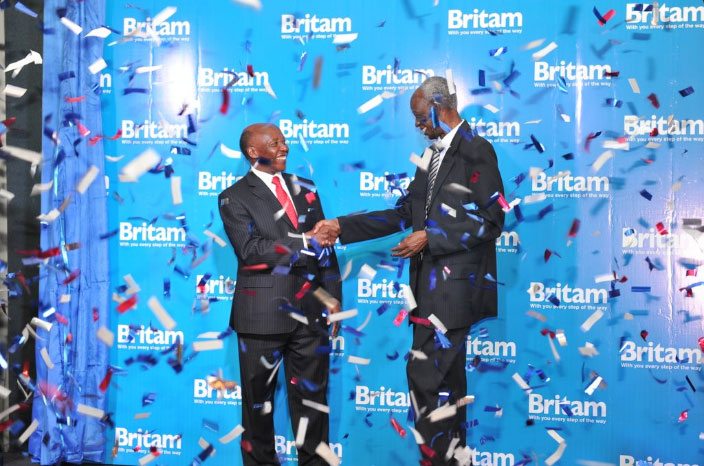
Britam Holdings is one of Kenya’s best known insurance brands and the country’s leading life insurer by market share.
It began as a tiny Nairobi office selling weekly premium policies and has grown into a diversified financial services group operating across seven African markets.
Its recent story is one of recovery: from a record loss in 2020 to a steady climb back into profit. Here’s the full picture.
History and Founding Story
Britam’s story in Kenya starts in 1965, when the British-American Insurance Company opened its first Nairobi office on University Way as a foreign branch of its Bahamas headquartered parent, a company first incorporated in Nassau in 1920.
The office began with fewer than ten employees, yet it served as the regional head office overseeing the parent’s operations in several other countries.
Its early product was modest but clever. The company sold small insurance policies to industrial workers, known as Weekly Premiums, because agents physically collected the premiums from clients’ homes every week, often riding motorbikes from door to door.
Those agents doubled up as the sales team, an agent led distribution culture that Britam’s “Blue Eagles” financial advisors still carry on today.
In 1979, a Kenyan government directive required all foreign owned insurers to incorporate locally, and British American Insurance Company (Kenya) Limited was born as a private company with nine branches.
In 1984, local investors acquired 33.33% of the shares in line with further government localisation rules, and the business gradually became Kenyan owned.
A holding company structure followed, along with a dedicated asset management arm, and in 2010 the group began its regional expansion by opening in Uganda. It listed on the NSE in 2011 and later rebranded as Britam.
The past decade has had dramatic ups and downs. Founders ceded control to institutional investors around 2018 and 2019, the group booked a record KSh9.11 billion net loss in 2020 amid the pandemic and portfolio write downs, and a turnaround strategy called EPIC² (2021 to 2025) then restored it to profitability.
In 2025, Britam marked its sixtieth anniversary and closed that strategy, before launching a new five year plan called ASCEND (2026 to 2030).
Core Business Lines / Revenue Streams
Britam earns money from insurance underwriting, fees on the funds it manages, and returns on the large investment portfolio that policyholders’ premiums build up.
- Life assurance and pensions: Life insurance, retirement planning, and savings and investment products. This is Britam’s traditional strength and its biggest franchise.
- General insurance: Motor, property, health, and other short term covers for individuals and businesses, a segment where Britam is one of the few consistently profitable players.
- Asset management: British American Asset Managers earns fees investing money for pension schemes, institutions, and retail clients.
- Property: Britam owns Britam Tower in Upper Hill, Nairobi, a 32 storey building with roughly 350,000 square feet of lettable space and occupancy above 90% in recent years, plus other investment property.
- Banking exposure through HF Group: Britam holds a 49.89% stake in mortgage lender HF Group (as of December 2025), accounted for as an associate rather than a subsidiary. That stake’s value more than doubled in 2025 as HF’s share price surged.
- Regional insurance subsidiaries: Operations in Uganda, Tanzania, Rwanda, South Sudan, Mozambique, and Malawi, alongside Kenya.
In 2025, the group’s insurance revenue rose to KSh41.7 billion, while net investment income reached KSh31.9 billion.
Investment returns are a very large part of Britam’s earnings, which is typical of insurers holding treasury bills, bonds, equities, and property.
READ ALSO:Inside the NSE: Diamond Trust Bank Kenya (DTK)
Competitive Position in Its Industry
Britam’s standout position is in life insurance. According to the Insurance Regulatory Authority, it holds roughly a quarter of the Kenyan life insurance market (about 25.1%), making it the leader.
In general insurance, it is Kenya’s second largest insurer with a market share of about 9.7%.
Industry recognition backs this up. At the Association of Kenya Insurers awards for 2025, Britam Life Assurance won Life Insurance Company of the Year for a record nineteenth consecutive year, and Britam General Insurance was named General Insurance Company of the Year.
The Brand Finance Kenya 2025 report also named Britam the country’s most valuable insurance brand and its third strongest brand overall across all industries.
Its main NSE listed rivals include Jubilee Holdings, CIC Insurance Group, Kenya Re, and the newly merged Sanlam Allianz Holdings Kenya, alongside large unlisted players.
Where Britam differs is its blend of scale in life insurance with a broad regional footprint and a large agent network.
Recent results show the recovery is real but still building. Full year 2025 net profit rose 10% to KSh5.5 billion, and in the half year to June 2026 net profit jumped 53.3% to KSh2.66 billion, helped by stronger underwriting and lower expenses, even as falling interest rates weighed on investment income.
Ownership Structure
Britam is privately owned and publicly traded. It is not state owned, and since the late 2010s it has been shaped by a mix of private equity, foreign institutions, and its founding investors.
Based on the latest shareholder data (September 2026), the largest holders are:
- AfricInvest: about 17.6%, a pan African private equity group that invested in Britam in the late 2010s.
- Equity Holdings Limited: about 9.18%, a notable link between two companies in this series.
- Swiss Re: about 9.14%, the Zurich based reinsurer that built its stake by buying from founders in 2018 and 2019.
- Endeavour ABRA Holdings: about 5.96%.
- Founding investors: Jimnah Mbaru (about 5.15%), Benson Wairegi (about 4.03%), James Mwangi (about 2.97%), and Peter Munga (about 2.76%), who together once held around 39% of the company but have since reduced their stakes.
- General public: about 43.2% of the register, including retail investors and local institutions such as pension funds.
The International Finance Corporation (IFC, part of the World Bank Group) also became a shareholder during the group’s 2016 to 2018 capital raising. The key point for readers is that founders ceded control to institutions, which changed the company’s governance and strategy.
Why It’s Listed on the NSE Specifically
Britam listed on the NSE in 2011 through an initial public offering, primarily to raise capital for growth. Insurance is a capital hungry business, since regulators require insurers to hold minimum capital, and Britam wanted funds to expand beyond Kenya into Uganda and other markets, to invest in property, and to build its asset management business.
The IPO was undersubscribed, largely because risk averse foreign investors shunned it during the Eurozone crisis and a sluggish US economy. Still, the listing gave Britam public market credibility and a share register it could return to.
That proved valuable later, when the group raised roughly KSh9.2 billion by issuing new shares to IFC and AfricInvest, and again when strategic investors like Swiss Re bought into the company on the exchange and through private deals.
For Kenyan investors, the NSE listing offers one of the few ways to own a large, diversified insurer with exposure to life assurance, general insurance, asset management, property, and banking through the HF Group stake.
Current Stock Price
As of 28 September 2026, Britam’s share price was roughly KSh19, based on the company’s market capitalisation of about KSh47.7 billion across around 2.5 billion shares.
That is a striking climb from around KSh5 in 2023, reflecting the group’s recovery in profit, the rally in the NSE overall, and the rise in the value of its HF Group stake.
Share prices move daily. For a live quote, check the NSE’s official market data page or a licensed brokerage platform before making any decisions.
How to Buy Britam Shares
You don’t need to be in Kenya to buy BRIT shares; it can be bought locally or from abroad:
- Open a CDS (Central Depository System) account. This is Kenya’s electronic share registry account, required to hold any NSE listed stock. It’s opened through a licensed stockbroker or investment bank.
- Choose a licensed NSE stockbroker or investment bank. Examples include firms like Standard Investment Bank, AIB-AXYS Africa, Genghis Capital, and Faida Investment Bank. A full list of licensed trading participants is available on the NSE website.
- Fund your trading account via bank transfer, mobile money (M-Pesa is widely supported), or card, depending on the broker.
- Place an order for BRIT through the broker’s trading platform, app, or by instructing your broker directly, specifying the number of shares or amount you want to invest.
- For non resident and diaspora investors, several online platforms (such as mystocks.africa and similar cross border brokerages) let you open an account remotely, fund it in USD or your local currency, and buy NSE listed shares like BRIT without needing an in country presence, though you should confirm licensing and custody arrangements before using any platform.
- Hold and track. Shares are held electronically in your CDS account. Note that Britam has not paid dividends for several years (the last payment I could confirm was KSh0.25 per share in 2019). Management has signalled a return to dividends as profits recover, but no payout was recommended with the half year 2026 results, so check the latest announcements before assuming income from the shares.
This profile is for informational and editorial purposes and is not investment advice. Stock prices, especially, change constantly, so always verify current figures with the NSE or a licensed broker before making any investment decision. Other figures reflect the most recent publicly reported data as of 2026 and may change with new financial disclosures.





Leave a Reply