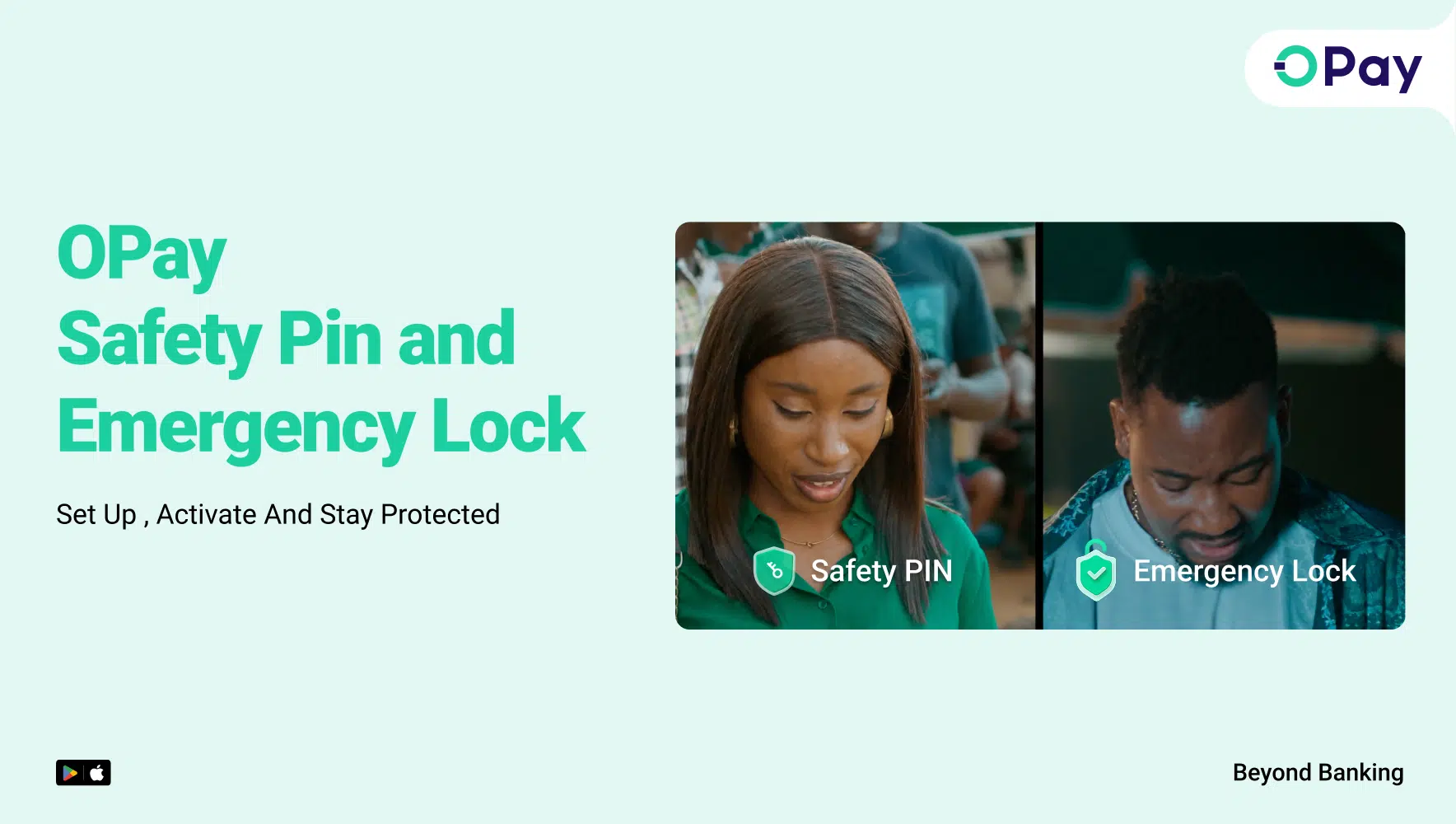
OPay has introduced two new security features that shift fraud protection from reactive to preventive, giving customers in Nigeria the ability to freeze their accounts instantly or trigger a silent lockdown under coercion, without alerting the person applying pressure.
The launch addresses a gap that has become increasingly visible as digital payment volumes in Nigeria have grown: most fraud prevention infrastructure is designed to detect and respond after an unauthorised transaction has occurred, not to stop one in real time when a customer is the target of theft, robbery, or social engineering.
OPay Emergency Lock Safety PIN changes that calculus by putting the intervention capability directly in the customer’s hands before money leaves the account.
Emergency Lock is the more straightforward of the two features. Accessible through the Security Centre in the OPay app, it allows a customer to freeze their account with a single tap.
Once activated, all outgoing transactions, including transfers, bill payments, and card transactions, are blocked for a 24-hour protection period.
The lock cannot be reversed during that window, a design choice that is deliberate rather than incidental.
Making the freeze irreversible for 24 hours removes the possibility that a fraudster, thief, or social engineer who has gained access to the customer’s phone or personal information can talk or force the customer into undoing it.
The protection period holds regardless of what happens after the lock is applied.
Safety PIN operates on a different threat model. It is designed for situations where a customer is physically present and being coerced into authorising a transaction: a robbery, a forced transfer, or any scenario where refusing to complete a payment carries personal risk.
READ ALSO :PalmPay POS Price, FairMoney Loans & OPay Agent Sign-up Explained
The customer sets up a separate Safety PIN in advance, distinct from their standard transaction PIN. If that PIN is entered during any transaction, it silently triggers a 24-hour account freeze without displaying any visible indication that a freeze has been activated.
The transaction appears to proceed normally to anyone watching, while the account is simultaneously locked against outgoing payments.
The OPay Safety PIN silent account freeze coercion protection Nigeria digital payments feature addresses a threat that is documented but rarely discussed in fintech security literature: the moment when a customer cannot safely refuse to cooperate.
Standard security advice, changing a password, and refusing to share credentials are inapplicable when the person demanding access is physically present and the customer faces immediate personal risk.
Safety PIN is an engineering response to a human safety problem, and its design reflects the kind of on-the-ground understanding of how fraud and theft actually manifest in the Nigerian context that a company operating at OPay’s scale accumulates over time.
Dotun Adekunle, Chief Operating Officer and Chief Technology Officer at OPay, confirmed that both features were developed in direct response to real-life security challenges faced by OPay’s Nigerian customers, with the goal of delivering greater confidence and control in an environment where digital transactions have become the primary mode of financial activity for millions of people.
The OPay new security features instant account freeze fraud prevention Nigeria fintech 2026 launch lands in a market where the stakes of getting security wrong are high and visible.
Nigeria’s digital payment ecosystem has grown rapidly, driven by mobile money adoption, the expansion of fintechs like OPay, and the Central Bank of Nigeria’s sustained push toward a cashless economy.
That growth has been accompanied by a corresponding increase in digital fraud attempts, phone theft, and social engineering targeted at mobile payment users.
Fintech security Nigeria 2026 is not an abstract compliance concern but a daily operational reality for providers serving tens of millions of active users.
How OPay Emergency Lock protects customers from financial fraud and coercion Nigeria is best understood as a layered system rather than a single control.
Emergency Lock handles the scenario where a customer has time to act, a stolen phone, a suspicious login, or an account they want to secure before a risk materialises.
Safety PIN handles the scenario where acting visibly is not safe. Together they cover the two most common high-risk situations that digital payment users in Nigeria encounter: loss of device control and physical coercion.
The OPay Emergency Lock Safety PIN digital payment security Nigeria 2026 features are available now through the Security Centre in the OPay app.
Both require no additional hardware and no interaction with customer support to activate, which is central to their utility: a security feature that requires a phone call or a branch visit to trigger offers no meaningful protection in the moments when protection is most needed.
The value of both tools is precisely that they work instantly, silently where required, and without dependency on any infrastructure beyond the app already in the customer’s hand.








Leave a Reply