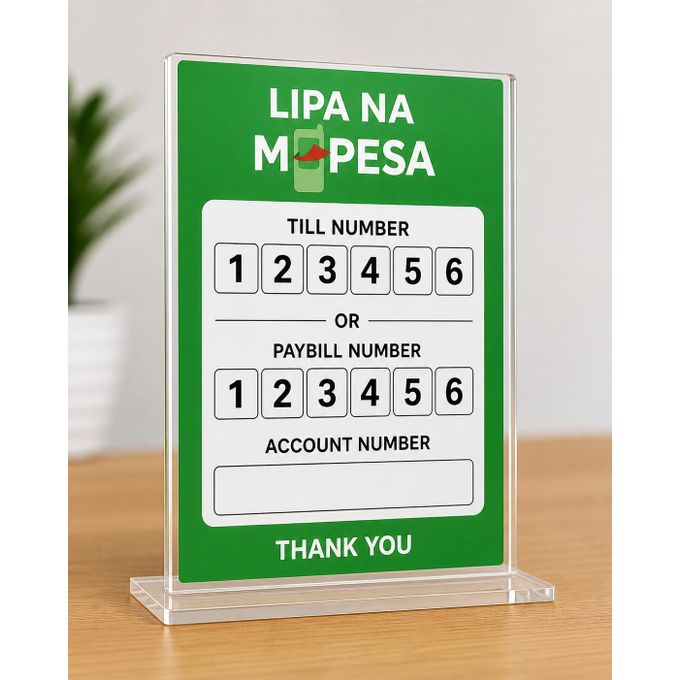
Ask ten Kenyan business owners the difference between a Paybill and a Till Number, and most will say they are basically the same thing.
They are not. The two products solve different problems, and the one you choose can quietly affect your monthly costs.
Here is what actually separates them and which option tends to save more money.
The Core Difference
A Till Number, officially called Lipa na M-Pesa Buy Goods, is built for point of sale payments.
A customer walks up, selects Buy Goods, enters your Till number and the amount, then confirms with their PIN.
No account number is needed. The merchant simply receives the money.
A Paybill works differently. It requires the customer to enter an account number alongside the amount.
That account number tells the business exactly what the payment is for.
This is why utility companies, schools, landlords, and SACCOs rely on Paybill.
A landlord using a Till has no way of knowing which tenant paid what.
A landlord using a Paybill can set the house number as the account reference and reconcile instantly.
In short, Till is for speed at the counter. Paybill is for accuracy behind the scenes.
READ ALSO:Pochi la Biashara vs Till Number: Which Is Better for Small Traders?
Who Actually Pays the Fee
This is where most confusion happens, and where real savings are decided.
On a Till Number, the customer always pays nothing. Safaricom removed customer charges on Buy Goods transactions years ago.
The business absorbs a settlement fee instead, typically between 0.5 and 1.5 percent of the transaction value, deducted before the money reaches the merchant account.
On a Paybill, the fee structure depends on which tariff the business selects.
There are generally three options. Under Business Bouquet, the business absorbs the transaction cost and the customer pays nothing.
Under Customer Bouquet, the customer pays the standard M-Pesa fee, similar to a regular send money charge. Under Mgao, the cost is split between both parties.
This means two Paybill numbers can behave completely differently.
One business might make payments free for its customers, while another quietly passes the fee on to them.
There is no way to tell just by looking at the number, so it is worth asking a business directly which tariff they use before paying a large amount.
Which One Actually Saves You More
For customers, a Till Number is almost always cheaper, since it costs nothing regardless of the amount.
A Paybill on Customer Bouquet can cost anywhere from a few shillings to over one hundred shillings on a single large transaction.
For businesses, the answer depends on volume and negotiation.
On comparable transaction volumes, a Till Number tends to be slightly cheaper than a Paybill, since Buy Goods settlement rates are generally lower.
Smaller businesses without negotiating power usually pay between 1 and 1.5 percent on Paybill, making Till the more economical choice at that scale.
However, high volume merchants can negotiate Paybill rates as low as 0.2 to 0.4 percent, which can undercut a standard Till fee.
Every payment looks identical except for the amount and time it arrived.
If your business needs to match payments to specific customers, accounts, or invoices, the reconciliation benefit of a Paybill can outweigh its slightly higher cost.
Making the Right Call for Your Business
If you run a shop, restaurant, salon, or any business where customers pay once and walk away, a Till Number usually wins.
It is free for the customer, generally cheaper for you, and faster at the counter.
If your business bills recurring accounts such as rent, school fees, utilities, or loan repayments, a Paybill is worth the extra cost.
The ability to automatically match each payment to the correct account saves hours of manual reconciliation every month.
Many established businesses eventually run both. A Till sits at the counter for walk in customers, while a Paybill handles invoiced or recurring collections.
Before committing to either, calculate your typical transaction size and monthly volume, then compare the real fees rather than assuming one option is universally cheaper.
The right choice depends less on which product is newer and more on how your business actually collects money.







Leave a Reply