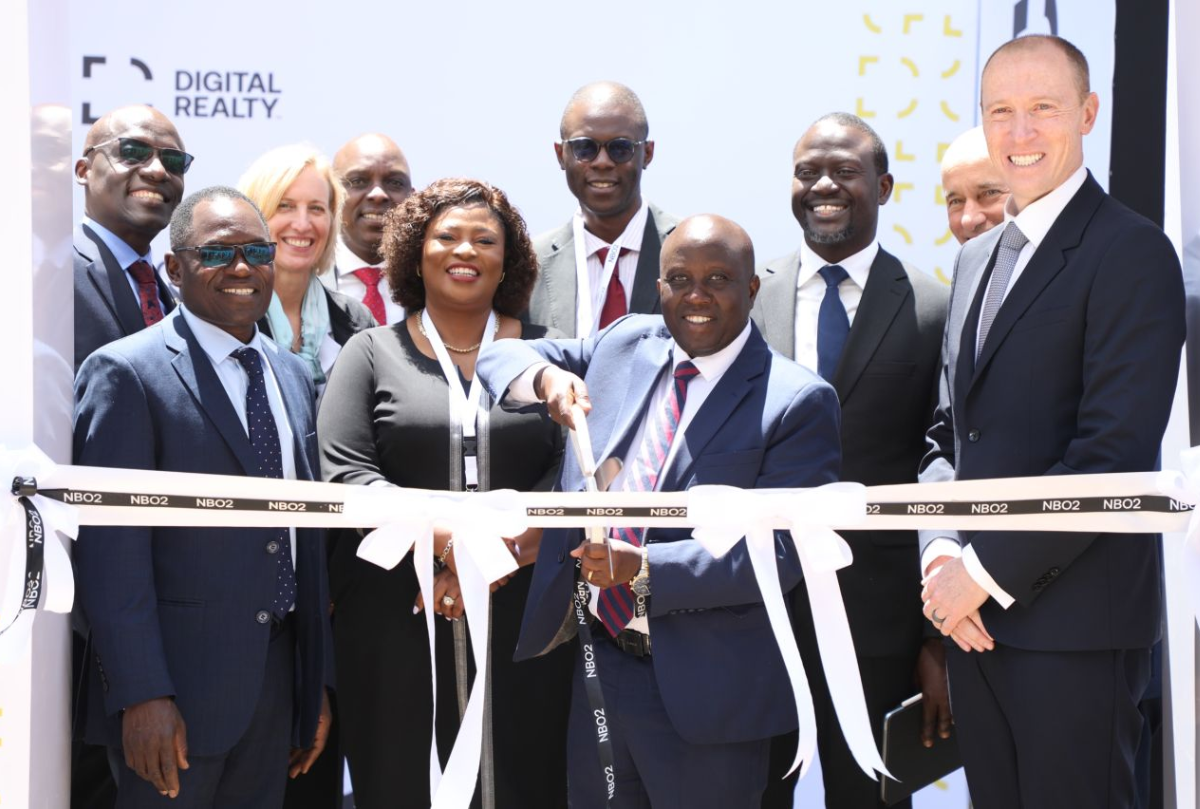
Digital Realty officially opened its Nairobi Two Data Center on September 7, 2026, adding 6.4 megawatts of capacity to its campus in Karen and completing iColo’s rebrand into the Digital Realty name across Kenya and Mozambique.
The launch doubled Digital Realty’s Nairobi footprint overnight and arrived alongside a direct government challenge to scale even further, a combination that says as much about where East Africa’s digital infrastructure race is headed as the facility itself.
Inside the Digital Realty Nairobi Two NBO2 Launch
The Digital Realty Nairobi Two NBO2 facility spans 12,000 square feet and sits roughly 300 metres from Nairobi One, the original iColo data centre that opened in the same Karen neighbourhood back in 2019.
Together, the two buildings allow customers to deploy critical workloads across separate physical sites while maintaining continuity, a setup that matters for enterprises and cloud providers that need redundancy without leaving the local market.
NBO2 connects customers to more than 100 networks, two internet exchange points and a satellite teleport, the last of which offers an additional connectivity route into locations where terrestrial fibre infrastructure remains limited, an important detail in a region where connectivity quality still varies significantly outside major urban corridors.
Digital Realty iColo Kenya: From Acquisition to Full Rebrand
The Digital Realty iColo Kenya relationship dates back to 2019, when Digital Realty’s predecessor Interxion took a controlling stake in iColo, the carrier neutral data centre operator that had built out facilities across Kenya and Mozambique.
The NBO2 launch marks the point where that acquisition becomes fully visible to the market, with iColo’s operations in both countries formally adopting the Digital Realty brand and folding into the company’s global PlatformDIGITAL infrastructure network.
Digital Realty Kenya Country General Manager Wanja Muriithi described the moment succinctly, saying the opening of NBO2 and the brand transition are part of one story, the continued growth of Kenya’s digital economy and iColo’s evolution within a global platform.
That framing matters beyond branding. Being formally absorbed into a global operator’s platform gives local customers access to a much larger network of interconnection points and cloud on-ramps worldwide, while giving Digital Realty a fully integrated East African foothold it can market alongside its facilities on other continents.
Why Nairobi Data Center East Africa Positioning Keeps Strengthening
Nairobi data center East Africa positioning has been building for years, and NBO2 reinforces rather than originates that trend.
Kenya has steadily marketed itself as a technology gateway for East and Central Africa, a strategy that depends on more than data centre floor space alone.
International submarine cables, national fibre backbones, cross border connectivity agreements, cloud infrastructure and facilities capable of hosting demanding computing workloads all have to work together for that positioning to hold up in practice.
NBO2’s dense interconnection ecosystem, spanning more than 100 networks and multiple exchange points, is meant to reinforce exactly that layered value proposition rather than treating raw power capacity as the whole story.
READ ALSO:How Angani’s LINX Nairobi Membership Is Strengthening East Africa’s Cloud Infrastructure
The launch itself was held at the Catholic University of Eastern Africa, a location organizers pointed to deliberately, noting that IBM established its Kenyan presence at the same institution roughly 13 years earlier, framing the venue as an example of how university, industry and government partnerships have long shaped the country’s technology ecosystem.
Government Ambition Outpaces the Facility Itself
Speaking at the launch, ICT and Digital Economy Principal Secretary John Tanui challenged Digital Realty to consider expanding capacity toward 20 megawatts, more than three times NBO2’s current output, as Kenya prepares for what officials expect will be a sharp rise in demand from artificial intelligence and other data intensive technologies.
That challenge captures the tension sitting underneath this launch. A 6.4 megawatt facility is a meaningful addition to East Africa’s digital infrastructure market, but government officials are already signalling that Kenya’s ambitions extend well past what any single new facility, however welcome, can satisfy on its own.
East Africa Digital Infrastructure 2026 and What Comes Next
East Africa digital infrastructure 2026 momentum is being shaped by the same forces driving data centre investment globally: rising cloud adoption, enterprise digitalisation, data sovereignty requirements that push organisations to keep data within specific jurisdictions, and surging computing demand tied to AI workloads.
NBO2 is explicitly designed to serve cloud providers, financial institutions, enterprises and internet service providers navigating exactly these pressures, giving organisations a way to keep critical data and applications within Kenyan borders while still maintaining connections to global platforms and partners.
What happens next will be more measurable than the launch event itself.
Industry observers are watching for the publication of promised government guidelines on priority data centre locations, whether Digital Realty’s Nairobi campus proceeds to a third facility and a dedicated captive substation to support further growth, and which specific cloud providers and regulated institutions ultimately take up capacity inside NBO2.
Those decisions, more than the ribbon cutting itself, will determine whether Nairobi’s data centre expansion keeps pace with the government’s stated ambitions or whether the gap between Kenya’s digital infrastructure rhetoric and its installed capacity continues to widen as AI driven demand accelerates across the region.







Leave a Reply