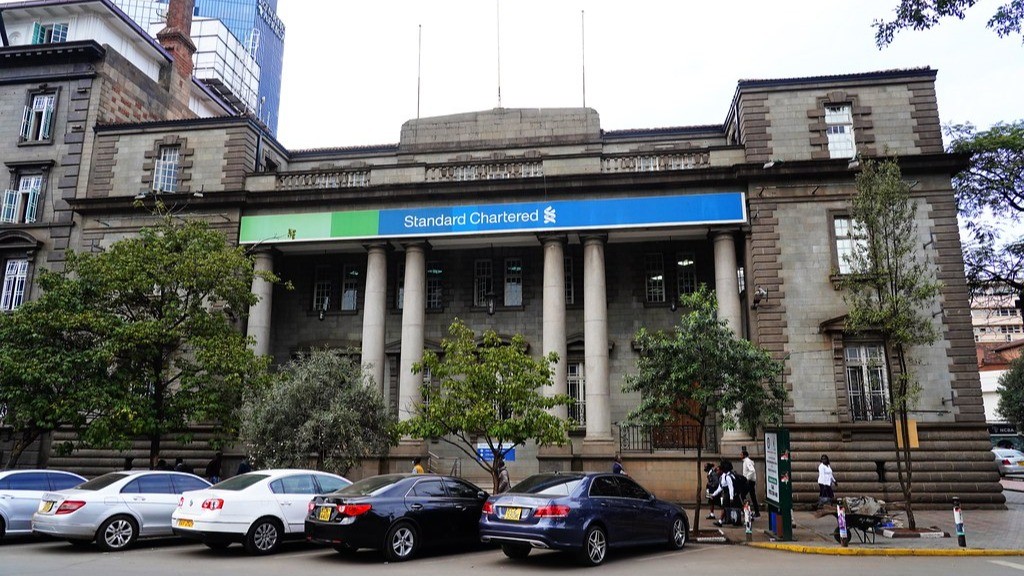
Standard Chartered’s presence in Kenya predates the country itself by half a century.
The bank’s roots trace to the Standard Bank of South Africa, which was licensed in 1910 and opened its doors in Mombasa on the morning of January 11, 1911, at Treasury Square, right at the port that anchored trade along the Kenya Uganda railway line.
A Nairobi branch followed within the same year, and by 1912 the bank had pushed inland as far as Eldoret.
For decades the bank operated under the Standard Bank name, serving the trade routes of the British East Africa Protectorate.
That changed in 1969, when its parent company merged with the Chartered Bank of India, Australia and China to form Standard Chartered Bank globally, and the Kenyan operation was renamed Standard Chartered Bank of Kenya to match.
In 1987, Standard Chartered fully divested its remaining shareholding in the old Standard Bank of South Africa, cementing its identity as a wholly separate institution from its historic South African namesake.
The bank went public on the Nairobi Securities Exchange in 1989, offering 21 million shares to the public in what was, at the time, the largest single share placing the exchange had ever handled.
It has remained listed ever since, building a long list of local firsts along the way, including Kenya’s first ATM banking center, the first unsecured personal loan product, and the introduction of mobile banking as early as the 1980s.
Today, having operated continuously in the country for well over a century, Standard Chartered Bank Kenya describes itself as the largest international bank in the country, headquartered in Westlands, Nairobi.
Core Business Lines and Revenue Streams
Standard Chartered Kenya organizes its business around two main segments:
- Corporate and Investment Banking: serving large corporates, institutions, and multinational clients with cross border trade finance, cash management, securities services, foreign exchange, syndicated loans, bonds, and structured products. This has historically been the bank’s core strength, leveraging its global network to help Kenyan and multinational businesses move money and manage risk across borders.
- Wealth and Retail Banking: personal current and savings accounts, fixed deposits, personal loans, salary overdrafts, home and construction mortgages, and wealth management products such as mutual funds, fixed income securities, and international banking services for individuals, alongside insurance products like motor, travel, and life cover distributed through the bank.
- SME banking: business current accounts, international trade accounts, and business savings products aimed at small and medium sized enterprises.
Beyond its own balance sheet, the bank hosts a regional Shared Service Centre in Kenya supporting Standard Chartered’s technology operations across Uganda, Tanzania, Zambia, Botswana, and South Africa, underscoring Kenya’s role as a hub within the group’s African network.
Financially, 2025 was a tougher year: total operating income fell about 16.5 percent to Ksh 42.3 billion, and core earnings per share dropped 38 percent to Ksh 32.9, driven mainly by weaker foreign exchange income and broader revenue pressure.
Even so, the bank remained highly capitalized, with a core capital to risk weighted assets ratio of 20.4 percent, roughly double the regulatory minimum.
Competitive Position in the Industry
Standard Chartered Kenya sits in an unusual competitive position: it’s smaller by assets than Kenya’s largest domestic banks (KCB, Equity, Co-operative Bank, NCBA, and I&M all carry larger balance sheets), yet it remains one of the country’s most prominent Tier 1 institutions and, by its own account, the largest purely international bank operating in Kenya, distinct from partially foreign owned domestic banks like Absa.
Its competitive edge lies less in sheer scale and more in specialization.
The bank has built a strong franchise in corporate and investment banking, wholesale trade finance, and wealth management for affluent clients, areas where its global network and multinational client relationships give it an advantage that purely domestic banks struggle to match.
READ ALSO:INSIDE THE NSE: I&M Group (IMH)
It has also positioned itself around sustainability financing, reporting sustainable finance assets rising to roughly Ksh 62.5 billion as part of its environmental, social, and governance strategy.
That said, the bank has faced real headwinds. Its 2025 results showed declining profitability driven by weaker trading income, and its regional peer Standard Chartered Uganda recently sold off its wealth and retail banking portfolio to Absa Uganda to refocus purely on corporate banking, a signal of how the wider Standard Chartered group is reshaping its African strategy toward higher margin, less capital intensive business lines.
Ownership Structure
Standard Chartered Kenya has one of the most straightforward ownership structures among NSE listed banks: it’s majority owned by its London headquartered parent, Standard Chartered PLC, through Standard Chartered Holdings (Africa) BV, an entity that has held its position for decades.
Current disclosures put the parent’s stake at approximately 74 percent, a level that has stayed broadly stable over many years.
The remaining shares, a little over a quarter of the total, are held by the investing public: more than 30,000 individual and institutional shareholders trade the stock freely on the NSE.
This structure has changed very little over time compared to some of its Kenyan peers, reflecting Standard Chartered’s long term commitment to keeping its African subsidiaries majority controlled while maintaining local public listings for governance and capital raising purposes.
Why It’s Listed on the NSE Specifically
Standard Chartered’s NSE listing reflects both its deep local roots and Kenya’s regulatory framework for foreign owned banks:
- A listing history stretching back to 1989: Standard Chartered’s Kenyan share offering was, at the time, the largest single placing the NSE had ever conducted, giving the bank one of the longest continuous listing records of any company on the exchange.
- Local incorporation and regulation: Standard Chartered Bank Kenya Limited is incorporated in Kenya and licensed by the Central Bank of Kenya, distinct from its UK parent, which means it falls under Kenyan banking and securities regulation and naturally lists on the domestic exchange.
- Public participation requirements and local accountability: like other major banks operating in Kenya, keeping a meaningful public float on the NSE, currently over a quarter of shares held by more than 30,000 shareholders, subjects the bank to local disclosure, governance, and reporting standards that a purely private foreign subsidiary would not face.
- A regional hub role reinforcing local presence: since Standard Chartered Kenya hosts shared technology and service functions supporting several other African markets, maintaining a strong, publicly accountable presence in Nairobi supports the bank’s broader East and Southern African operations.
Current Stock Price
As of early September 2026, SCBK was trading around Sh343.75 on the Nairobi Securities Exchange, having touched an all time high of Sh370 in April 2026.
That put the bank’s market capitalization at roughly Sh125 to 130 billion, depending on the exact trading session referenced.
The stock has been a strong performer over the past year despite the bank’s weaker 2025 earnings, partly reflecting its historically high dividend payout, but prices move daily and can shift quickly on results announcements or currency swings.
Treat this figure as a historical snapshot rather than today’s number, and check the live price through the NSE website, your broker’s trading platform, or a live data source such as African Markets or myStocks before making any decisions.
How to Buy Standard Chartered Bank Kenya Shares
Buying SCBK shares (or any NSE listed stock) follows the standard process used across the Kenyan market:
- Open a CDS account. A Central Depository System (CDS) account holds your shares electronically. You can open one through the Central Depository and Settlement Corporation (CDSC), though most investors do this through a licensed stockbroker as part of onboarding.
- Choose a licensed stockbroker. You’ll need an NSE licensed brokerage, such as Faida Investment Bank, AIB-AXYS Africa, Genghis Capital, or Standard Chartered’s own investment arm, Standard Chartered Securities, to place trades. Most offer mobile or online trading platforms.
- Fund your trading account. Deposit money into the account linked to your broker, typically through bank transfer or mobile money, depending on what the brokerage supports.
- Place your buy order. Specify the ticker (SCBK), the number of shares, and your price, either a market order at the prevailing price or a limit order at a price you set. Orders match through the NSE’s electronic trading system.
- Diaspora and foreign investor options. Kenyans abroad and foreign investors can buy SCBK shares too. Many Kenyan brokerages support remote account opening with certified identification, and some platforms allow USD settlement, letting diaspora investors trade without being physically present in Kenya.
- Track your holding. Once the trade settles, usually within a few business days, the shares reflect in your CDS account. You can follow price movement, dividend announcements, and corporate actions through your broker’s platform, the NSE website, or financial data sites carrying live NSE quotes.
As with any equity investment, share prices can go down as well as up, and this isn’t financial advice. It’s worth doing your own research, or speaking with a licensed financial advisor, before buying.





Leave a Reply