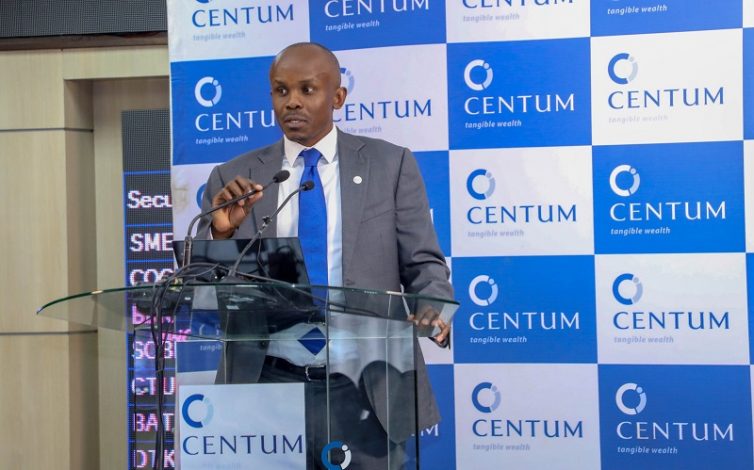
Centum began in 1967 as ICDC Investment Company Limited, set up by the Industrial and Commercial Development Corporation (ICDC), a Kenyan state corporation, and listed on the Nairobi Stock Exchange the same year.
For its first three decades it was effectively an investment arm of the state. In 1998, after the government sold down part of its majority holding, the company handed day to day management to an independent professional team under a board elected by shareholders.
In 2008 it was renamed Centum Investment Company. That same year (December 2008) James Mworia, then 30, became chief executive, and he would run the company for the next 18 years.
Under him Centum grew into what it describes as East Africa’s largest listed investment company, with stakes in real estate, financial services, energy, publishing, and private equity.
It also listed on the Uganda Securities Exchange in February 2011, under the ticker CENT.
Several big moves shaped the group. It bought a controlling stake in K-Rep Bank in 2015 and rebranded it Sidian Bank in 2016, and it planned to sell Sidian to Nigeria’s Access Bank in 2022 before calling that deal off in January 2023.
It built the Two Rivers development in Nairobi and the Vipingo development near Kilifi, both now designated Special Economic Zones, and it sold its pension fund manager GenAfrica to a fund managed by Kuramo Capital.
The recent chapters matter most for investors:
- Debt cleared: Centum says it repaid about Ksh 20 billion of group debt (including Ksh 16 billion at the listed company level) and reported a debt free company balance sheet at March 31, 2026.
- Sidian exit completed: on March 12, 2026, Centum sold its remaining 50% of Bakki Holdco, which held a 27.27% stake in Sidian, ending a link of more than two decades.
- Leadership change: on September 7, 2026, Mworia stepped down to become founding chief executive of the National Infrastructure Fund. Thomas Omondi-Achola, the group’s chief operating officer since 2018, is acting group CEO, and Donald Kaberuka chairs the board.
Core Business Lines and Revenue Streams
Centum organizes its holdings into three broad groups, plus a few service businesses:
- Private equity: stakes in unlisted and listed companies, managed through its subsidiary Centum Capital Partners. Examples include Akiira geothermal power and a stake in publisher Longhorn.
- Real estate and infrastructure: Centum Real Estate develops and sells homes and land, and the group holds Two Rivers (Nairobi, including a mall and a Special Economic Zone) and Vipingo (Kilifi). Company materials reported a portfolio of about 2,100 units, with 89% sold as of March 2024.
- Asset management and listed investments: through Nabo Capital.
- Security services: Tribus Security Group, in which Centum holds 80%.
A listed investment company earns in a few ways: dividends from the companies it owns, gains when it sells stakes, rises in the estimated value of its holdings, and property sales. That makes results lumpy. For the year ended March 31, 2026 (FY2026):
- Company level profit after tax rose 87% to about Ksh 1.02 billion, helped by Ksh 1.24 billion in cash distributions from portfolio companies, a Ksh 361 million property fair value gain, and 61% lower finance costs after debt repayment.
- Group profit after tax fell 8.5% to Ksh 744 million (from Ksh 813 million). The group’s pre-tax result turned to a Ksh 643 million loss, after a Ksh 964 million loss at the Two Rivers Special Economic Zone and a Ksh 792 million loss in development operations, and a Ksh 1.4 billion tax credit brought it back to a profit.
- NAV rose to about Ksh 46.3 billion, or about Sh69.5 per share (up from Sh66.93).
- Free cash flow was about Ksh 3.84 billion, up 19%.
The company’s own pitch for the next phase is a shift from paying down debt to returning more cash to shareholders, while it also secured a strategic investor for the 2,000 acre Vipingo Special Economic Zone, which it says funds the project’s completion without more equity from Centum.
Competitive Position in the Industry
Centum describes itself as the largest listed investment company in East Africa, and it has few direct listed rivals, since most NSE companies run an operating business rather than hold a portfolio.
Its competition is really for investors’ attention against private equity funds, real estate developers, and the other conglomerates and holding companies on the exchange.
Three points define its position:
- Scale and reach: a portfolio worth tens of billions of shillings, a dual NSE and Uganda listing, and a long record of attracting co-investors into its projects.
- A very wide discount: at about Sh17.90 a share against NAV of about Sh69.5, the stock trades at roughly a quarter of its stated NAV (my calculation). That gap signals that investors doubt how those holdings are valued, or how much cash will reach shareholders.
- A mixed track record: critics, including investigative commentary in Kenya, point to a decline in the dividend from Sh1.20 per share in 2019 to about Sh0.32 by 2024, a fall in NAV per share in FY2023, and exits and write-offs that returned less than the original cost (for example, total Sidian proceeds of about Ksh 4.47 billion against an invested cost of Ksh 4.77 billion, according to a Business Daily figure cited by one critic). Supporters point to the cleared debt, rising NAV, and the bigger dividend. Treat both sides as opinion and check the accounts.
READ ALSO:What You Should Know (and How to Buy) in the Dangote Refinery IPO
Ownership Structure
Centum’s register mixes a few large holders with a wide base of small ones. Based on a shareholder list from S&P Global data, as shown on Simply Wall St and reflecting a snapshot from around May 2025:
- Estate of the late Dr. Christopher Kirubi: about 32.4%, the largest holder.
- Kenya Development Corporation (the successor name for the state’s ICDC, Centum’s founder): about 24%.
- John Kimani: about 7.2%.
- Management: James Mworia holds about 0.9%, and Thomas Omondi-Achola about 0.13%.
The company has about 665 million shares in issue, with a small buyback programme (about 10.8 million shares repurchased for Ksh 97 million, according to FY2026 results).
Estimates of the free float differ widely, from about 33% in one market data source to 85% in an older analysis, because it depends on how large holders are counted.
Capital Markets Authority data reported in October 2026 puts local individual ownership at about 68%. Holdings change, so check the latest annual report before quoting a percentage.
Why It’s Listed on the NSE Specifically
Centum’s listing reflects its origins and its role as an investment vehicle:
- Born on the exchange: the company was formed in 1967 and listed the same year, making it one of the older NSE listings.
- A public channel into private assets: Centum presents itself as a way for ordinary investors to access a diversified portfolio of unlisted businesses, property, and infrastructure that they could not easily buy on their own. A listed holding company suits that purpose.
- Local incorporation and regulation: it is incorporated in Kenya, so the NSE and the Capital Markets Authority are its home regulators.
- Broader East African reach: the 2011 Uganda listing extended the shareholder base across the region, while the Nairobi listing remains the main market.
- Continuity through a change of control of its management: the state stepped back from day to day control in 1998, and the listing allowed ownership to broaden without Centum leaving the exchange.
Current Stock Price
As of October 23, 2026, CTUM closed at Sh17.90 on the Nairobi Securities Exchange, up about 1.1% on the day and about 29% since the start of the year. That puts its market value at roughly Ksh 11.7 billion, against a stated NAV of about Ksh 46 billion.
The company’s total dividend for FY2026 is Sh0.78 per share, made up of an ordinary dividend of Sh0.42 and a special dividend of Sh0.36, up from Sh0.31 the year before.
Market data lists the ex-dividend date as October 22, 2026 and payment on December 18, 2026.
On the October 23 price, Sh0.78 is about a 4.4% yield (my calculation), but the special dividend is a one-off, so the ordinary dividend alone is a better guide to what repeats.
Prices move daily, so treat this as a snapshot rather than today’s price. Check the live quote through the NSE website, your broker’s trading platform, or a data source such as African Markets or myStocks before making any decision. Half-year results are due around late November 2026.
How to Buy Centum Shares
Buying CTUM follows the standard process used across the Kenyan market:
- Open a CDS account. A Central Depository System (CDS) account holds your shares electronically. You can open one through the Central Depository and Settlement Corporation (CDSC), though most investors do this through a licensed stockbroker as part of onboarding.
- Choose a licensed stockbroker. You’ll need an NSE licensed brokerage, such as Faida Investment Bank, AIB-AXYS Africa, Genghis Capital, or SBG Securities, to place trades. Most offer mobile or online trading platforms.
- Fund your trading account. Deposit money into the account linked to your broker, typically through bank transfer or mobile money, depending on what the brokerage supports.
- Place your buy order. Specify the ticker (CTUM on the NSE), the number of shares, and your price, either a market order at the prevailing price or a limit order at a price you set.
- Diaspora and foreign investor options. Kenyans abroad and foreign investors can buy CTUM too. Many Kenyan brokerages support remote account opening with certified identification, and some platforms allow USD settlement. Because Centum is also listed in Uganda (ticker CENT), investors based there can trade locally.
- Track your holding. Once the trade settles, usually within a few business days, the shares reflect in your CDS account. Follow price movement, results, dividend announcements, and any news on the leadership transition through your broker’s platform, the NSE website, or financial data sites.
As with any equity investment, share prices can go down as well as up. This isn’t financial advice. It’s worth doing your own research, or speaking with a licensed financial advisor, before buying.



Leave a Reply