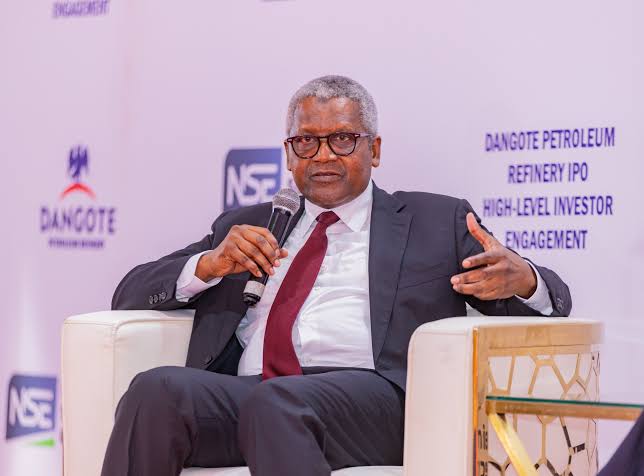
You cannot buy Dangote Refinery shares directly on the Nairobi Securities Exchange.
What Kenyans can buy is a Global Depositary Receipt, or GDR, a certificate that represents a Dangote share held in custody and that is meant to trade on the NSE in Kenya shillings.
This guide explains what that means, how to apply, and the risks that are specific to this structure, so you can decide before you put money in.
- The underlying deal is the Dangote Petroleum Refinery & Petrochemicals (DPRP) IPO in Nigeria, priced at ₦525 per share, for up to 4.1 billion new shares.
- The Kenyan route is a GDR programme run by Renaissance Capital (Kenya), with Stanbic Bank Kenya as custodian and receiving bank and Image Registrars as registrar.
- Each GDR represents one Dangote share. The price is Sh53.50 per GDR, paid in full when you apply, and the minimum is 10 GDRs (Ksh 535), as of October 2026.
- You are buying Dangote’s refinery in Lekki, Lagos. You are not buying the planned Dangote refinery in Lamu, Kenya. The Capital Markets Authority (CMA) made this point explicitly.
The Deal at a Glance
| Item | Detail (as of October 26, 2026) |
|---|---|
| Issuer of the GDRs | Renaissance Capital (Kenya) Limited |
| Type | Unsponsored inward GDR (see below) |
| Ratio | 1 GDR = 1 Dangote share |
| Price | Sh53.50 per GDR, fixed, paid in full on application |
| Minimum | 10 GDRs (Ksh 535). The Information Memorandum originally set 2,000 GDRs (Ksh 107,000). |
| Kenyan tranche | Up to 728,971,962 GDRs, about Ksh 39 billion at the offer price |
| Offer opened | October 6, 2026 |
| Offer closes | Tuesday, October 27, 2026 (extended from October 13). One notice gives 5:00 p.m. |
| Apply via | Portal: dangotegdr.e-offer.app, or USSD 483250# |
| Expected NSE listing | Around December 8, 2026, subject to approvals |
| Underwritten? | No |
What Is a GDR, in Plain Language?
A GDR lets you own an economic interest in a foreign company’s shares through your local exchange.
In this programme, Renaissance Capital applies for Dangote shares in Nigeria on behalf of all Kenyan applicants, holds them with a custodian, and issues you GDRs that are credited to your CDS account. The GDRs are intended to list and trade on the NSE in shillings.
Two features matter:
- Unsponsored: Dangote did not set up this programme. The company has given in-principle support, but it is not a party to the GDR terms and has no obligation to GDR holders. You are not a registered Dangote shareholder.
- Pass-through: corporate actions on the underlying shares, such as dividends, are passed through to GDR holders.
What You Need Before You Apply
- A CDS account. You cannot apply without one. Any licensed stockbroker or investment bank can open one.
- A Kenyan mobile number registered to you, if you want to use USSD. USSD is for individual investors only.
- Your ID and bank or M-Pesa details, since your application is checked against your CDS record and the offer requires KYC checks.
- Your money, in full. GDRs are paid for when you apply, not later.
How to Apply
Online Portal
Go to dangotegdr.e-offer.app. As described in the Information Memorandum:
- Read and accept the terms.
- Click “New Application” and enter your CDS details, which are verified against your CDS account.
- Fill in the electronic form and choose your applicant type (individual, institutional, or an agent applying on someone’s behalf).
- Pay and, if you pay by bank transfer, upload proof of payment. If you pay by M-Pesa, you can request a payment prompt to your registered number.
- Watch for status updates by email or text.
READ ALSO:How to Buy Quickmart Shares in the 2026 NSE IPO
USSD
Dial 483250#, read and accept the terms, choose “New Application,” and follow the prompts. You can use “Add Shares” to increase your application during the offer period and “Add Payment” to pay in parts, as long as the full amount is in before the offer closes.
Through an Agent
The Information Memorandum also lists authorised selling agents (stockbrokers and banks) in its appendix. If you are not comfortable with the portal, ask your broker.
How to Pay
All payments are in Kenya shillings.
- M-Pesa: by prompt, or by paybill 8250250 using your unique application serial number as the account. Up to Ksh 150,000 can be paid in one go, and you can make multiple payments to reach your total.
- Bank transfer (EFT or RTGS): to the Stanbic Bank Kenya receiving account shown on your application. Put your application serial number in the narration. The account number is unique to each application, so copy it from the portal, not from a blog or social media post.
- Cash and cheques are not accepted.
One timing warning: the terms ask investors paying by bank transfer to pay two days before the closing date, by 5:00 p.m.
The Information Memorandum also says payment must arrive in cleared funds by 5:00 p.m. on the closing date.
Confirm with the portal or your broker which applies after the extension, and if you are short on time, M-Pesa is likely the safer choice.
Your application is rejected if payment is short, late, or by cheque, or if KYC is not satisfied.
How Much Should You Apply For?
At Sh53.50 per GDR:
- 10 GDRs: Ksh 535
- 100 GDRs: Ksh 5,350
- 1,000 GDRs: Ksh 53,500
- 2,000 GDRs (the original minimum): Ksh 107,000
The offer is not guaranteed to fill, and your allocation is not guaranteed either. If applications exceed the shares Renaissance Capital receives, it can scale back applications with CMA approval, and refunds are paid without interest. Apply only what you are prepared to hold.
What Happens After You Apply
The timeline depends on the Nigerian IPO, so dates can move:
- October 27: Kenyan application list closes.
- Early November: returns are collated, and the allotment basis goes to regulators. Nigeria’s offer is expected to submit its basis of allotment to the SEC around November 10.
- After allotment: surplus and rejected money is refunded, then GDRs are credited to your CDS account, and the GDRs list on the NSE. The Information Memorandum puts both CDS crediting and listing about 15 business days after allotment, and a recent notice from the arranger points to around December 8.
- Dangote’s shares themselves are expected to list on the Nigerian Exchange around December 2, 2026.
Risks Specific to This Structure
- No guaranteed allocation. Renaissance Capital has not secured a guaranteed number of Dangote shares. Dangote’s board decides allotment. The offer is not underwritten, and it lapses if the minimum success threshold of Ksh 50 million is not met.
- The NSE listing is conditional. It needs a no-objection from Nigeria’s SEC. If that is not granted, the GDRs are not issued or listed. You would continue to hold your underlying shares through an omnibus account, and liquidity would come from selling shares on the Nigerian Exchange.
- Currency risk. The shares are valued in naira, while the GDRs trade in shillings. A weaker naira against the shilling reduces your GDR’s value even if Dangote’s share price in Nigeria does not change.
- Dividend risk. Dividends may be paid in naira or US dollars, converted into shillings, and paid net of fees and withholding taxes. Nigerian exchange controls could delay or block conversion.
- Tax friction. The Information Memorandum cites a 10% Nigerian withholding tax on dividends and notes there is currently no double taxation treaty between Kenya and Nigeria, so Kenyan tax may apply on top.
- No direct shareholder rights. You cannot vote individually. Voting is by a holders’ electronic vote, with the issuer exercising the votes in line with the result, and notice delays are a stated risk. You cannot sue Dangote directly as a shareholder.
- No swap into shares. There is no facility to exchange GDRs for the underlying Nigerian shares.
- Trading halts travel. If trading in Dangote shares is suspended in Nigeria, the NSE is likely to freeze the GDRs too.
- Thin liquidity risk. The GDRs must keep a minimum public free float, and a failure could lead to illiquidity or delisting.
- No retail perks. GDR holders are not eligible for the retail investor incentive programme in the Nigerian IPO.
- Costs. The Information Memorandum lists total transaction expenses of about Ksh 698 million, borne by holders rather than Dangote, plus a custody fee of 0.16% a year. By my arithmetic, that is roughly 1.8% of the Ksh 39 billion target size, but check the document for how costs are recovered.
If You Miss the Offer
If the GDRs list on the NSE, you can buy them like any other NSE share: get a CDS account, pick a licensed broker, fund your account, and place a market or limit order using the ticker the NSE announces at listing.
After listing, the price is set by the market. The Information Memorandum says it will differ from the Nigerian share price because of currency moves, expenses, and investor sentiment in Nairobi, so it may trade above or below your cost.
Before You Apply
Read the Kenya GDR Information Memorandum (on the NSE website) and Dangote’s own Information Memorandum dated September 7, 2026.
The CMA has said its approval is not a recommendation, and that GDRs have features that differ from ordinary NSE shares.
Share prices can go down as well as up, and you could lose some or all of your money. This guide is not investment, legal, or tax advice.



Leave a Reply