Sameer Africa is the NSE’s best known corporate reinvention: for fifty years it was the company behind the Yana tyre (“Africa rides on Yana tyres”) and Kenya’s only tyre maker, and today it is a landlord.
After years of losses, including a record KSh1.09 billion loss in 2019, it shut its tyre business in 2020 and has been profitable every year since, while its share price rose more than fivefold during 2025.
Here’s the full picture.
History and Founding Story
Sameer Africa began in 1969 as Firestone East Africa (1969) Limited, set up in Kenya by the American Firestone Tyre and Rubber Company together with the Government of Kenya to make tyres for the East African market.
When Japan’s Bridgestone bought Firestone in 1988, the Kenyan business had by then passed largely into the hands of Sameer Investments Limited, a Kenyan company belonging to the businessman Naushad Merali, who entered the tyre business in the late 1980s.
Bridgestone stayed on as a minority shareholder (holding about 15% at one stage) and the company later distributed Bridgestone tyres in Kenya.
The Merali side eventually bought out Bridgestone’s stake, lifting Sameer Investments from about 57% to about 72%.
The company listed on the Nairobi exchange in the mid 1990s (sources give 1 January 1994 or 1995), and in April 2005 it changed its name to Sameer Africa Limited, positioning itself as an independent Kenyan tyre company serving East Africa and the wider COMESA region.
At various points it was described as the leading and sole tyre producer in the region, with its own brands (Yana, Summit, and Firestone) as well as the Bridgestone distribution business.
The business struggled for years against cheap imported tyres, mainly from China. Even after the company outsourced production to India and China, it lost money in every year from 2014 to 2019, ending with the record loss of KSh1.09 billion in 2019.
In April 2020 the board decided to close the tyre business and concentrate on its real estate.
The closure cost about KSh223 million (KSh60 million in retrenchment and KSh163 million in asset write offs) and removed about KSh1.49 billion in annual revenue, but the company argued that profits would rise once the losses disappeared. They did.
Core Business Lines / Revenue Streams
Sameer Africa is now a property company, and 2025 was its first full year with all of its revenue coming from rent.
- Industrial and EPZ property (the core engine): Through its wholly owned subsidiaries Sameer Industrial Park Limited and Sameer EPZ Limited, it lets space to tenants, including firms licensed to operate in export processing zones. It says it offers more than 750,000 square feet of lettable industrial space, a mix of EPZ and non EPZ facilities, on its Mombasa Road site in Nairobi, including space that used to house the tyre factory.
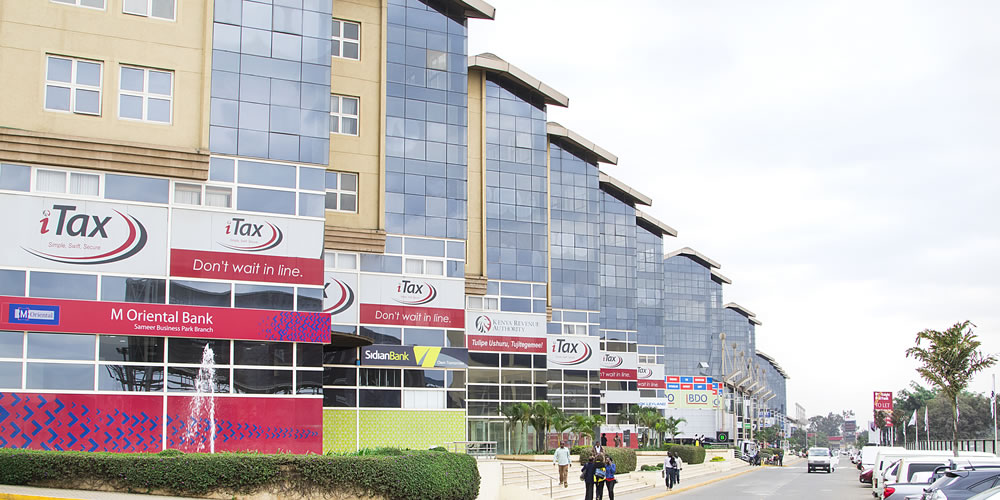
- Sameer Business Park: A 25% interest in a modern office and showroom complex on 8.8 acres along Mombasa Road.
- New development: A KSh260 million, 45,000 square foot built to suit warehouse (the Infill project), backed by a long term pre construction lease, expected to add about 8% to rental income.
- Land holdings and other rentals: Leasehold land, residential houses, and commercial property, plus undeveloped parcels earmarked for later development. Investors have long argued that the land, acquired cheaply decades ago, is worth much more than the share price implies.
- Land sales: A 3.75 acre parcel valued at KSh919 million has been up for sale since 2022. The deal has missed several completion dates because of financial difficulties at the buyer, and the company now targets mid 2026.
Revenue for 2025 was KSh432.7 million, up from KSh389.5 million in 2024.
Competitive Position in Its Industry
The company’s old competitive position is gone: Sameer is no longer a tyre maker, so it competes as a landlord in Nairobi’s industrial property market, mostly against private developers and other listed property players.
Its edge is cheap, well located land, especially along Mombasa Road, and its EPZ expertise: it describes itself as an experienced EPZ developer, with infrastructure aimed at export oriented tenants.
The numbers show a business that is working better than the tyre business ever did.
Net profit for 2025 rose 5.5% to KSh274.3 million, from KSh259.9 million in 2024, and operating profit jumped 47.7% to KSh292.6 million, the highest in more than a decade.
Earnings per share were KSh0.99, up from KSh0.93. Finance costs collapsed to KSh3.2 million from KSh130.3 million after the company used a deposit from the land sale to repay KSh540.6 million of loans.
READ ALSO:Inside the NSE: Kenya Airways (KQ)
Shareholders’ funds grew 37%. In the six months to June 2026, net profit rose a further 19.8% to KSh103.9 million from KSh86.7 million on lower operating expenses.
A caution on how to read this: part of the profit increase reflects falling finance costs, not just higher rent, and the rental income base is still small (KSh360 million in 2023, for example), so a few tenants leaving could matter.
Ownership Structure
Sameer Africa is controlled by a single holding company, with a small free float.
- Sameer Investments Limited: 72.5%, or 201.7 million of roughly 278 million shares. This is the Merali family’s investment vehicle, and it also has interests in other businesses including the Isuzu dealer Ryce East Africa. Sameer Merali, the founder’s son, has served on the Sameer Africa board since 2012 and is chief executive of Sameer Investments.
- Smaller holders: The Patrick Njogu Kariuki Family Trust (2.02%), Yana Trading Limited (1.89%), Andrew Musangi (1.19%), and a handful of small corporate and individual holders.
- General public: About 18.6% of the shares, with individual insiders holding about 1.2%.
The same Merali family network also appears elsewhere in this series: it holds a large stake in Sasini (through Yana Towers, about 13%) and once owned 35% of Eveready East Africa, a stake it sold in 2023.
Why It’s Listed on the NSE Specifically
Sameer Africa listed in the mid 1990s, when Firestone East Africa was a manufacturing company looking for a broader shareholder base.
The listing gave the Merali controlled company a public market, and it let the family keep control (about 57% before the Bridgestone buyout) while raising capital from outside investors.
The listing has taken on a different meaning in the property era. For a company whose main asset is land and buildings, the NSE quote provides a daily market price against which investors can measure the value of its property portfolio, and Business Daily has noted that the properties are worth more than double the company’s roughly KSh4.1 billion market capitalisation.
The listing also gave Sameer a public vehicle for the reinvention itself: shareholders could follow the closure of the tyre business, the move into rentals, and the land sale in regulated disclosures.
For investors, it offers a rare way to buy exposure to Nairobi industrial property through a listed company, though the free float is small.
Current Stock Price
Sameer’s share price has been one of the standout performers on the exchange.
It rose by about 441% in the first eight months of 2025, so that KSh100,000 invested at the start of the year was worth about KSh540,000 by August, and it was among the best performing counters on the NSE that year.
Liquidity has improved a lot, but trading is still modest: indicative liquidity over the twelve months to early April 2026 was about US$2.07 million (around KSh261 million), compared with about US$204,000 a year earlier.
Share prices move daily. For a live quote, check the NSE’s official market data page or a licensed brokerage platform before making any decisions.
How to Buy Sameer Africa Shares
You don’t need to be in Kenya to buy SMER shares; it can be bought locally or from abroad:
- Open a CDS (Central Depository System) account. This is Kenya’s electronic share registry account, required to hold any NSE listed stock. It’s opened through a licensed stockbroker or investment bank.
- Choose a licensed NSE stockbroker or investment bank. Examples include firms like Standard Investment Bank, AIB-AXYS Africa, Genghis Capital, and Faida Investment Bank. A full list of licensed trading participants is available on the NSE website.
- Fund your trading account via bank transfer, mobile money (M-Pesa is widely supported), or card, depending on the broker.
- Place an order for SMER through the broker’s trading platform, app, or by instructing your broker directly. Because the free float is small, limit orders are advisable.
- For non resident and diaspora investors, several online platforms (such as mystocks.africa and similar cross border brokerages) let you open an account remotely, fund it in USD or your local currency, and buy NSE listed shares like SMER without needing an in country presence, though you should confirm licensing and custody arrangements before using any platform.
- Hold and track. Shares are held electronically in your CDS account. Do not expect dividend income: the board recommended no dividend for 2025 or 2024, saying it prefers to reinvest in growth. The last payments I found were small dividends in the early 2010s (KSh0.25 interim in one year), but I did not trace a full dividend history.
This profile is for informational and editorial purposes and is not investment advice. Stock prices, especially, change constantly, so always verify current figures with the NSE or a licensed broker before making any investment decision.
Other figures reflect the most recent publicly reported data as of 2026 and may change with new financial disclosures.



Leave a Reply